

Indonesia, the world’s third-largest democracy, is preparing for a major political event: its simultaneous local elections in 2024. These elections will take place in over 500 regions, encompassing all provinces and districts, marking a monumental democratic exercise that reflects the nation’s strong commitment to electoral participation. As shown in the infographic I created, Indonesia’s electoral system follows a structured process supervised by the General Elections Commission (KPU). This process includes regulatory planning, budget allocation, voter verification, candidate registration, campaigning, and vote counting.
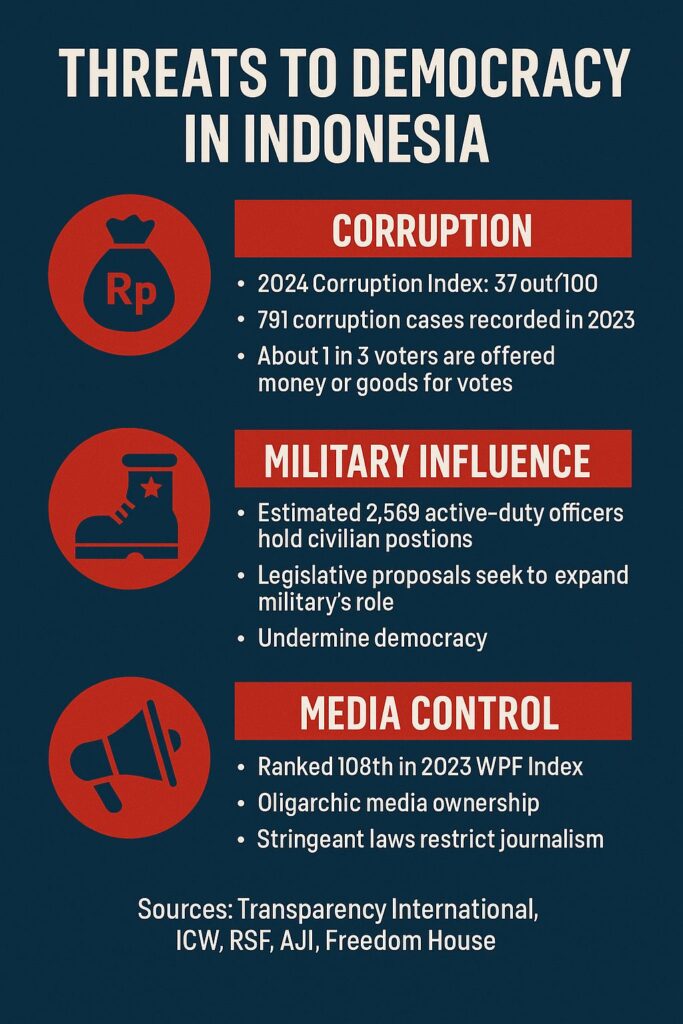
However, even the most carefully designed electoral system can falter if the broader political environment undermines democratic principles. To address this, I created a second infographic titled “Threats to Democracy in Indonesia,” which highlights three critical challenges: corruption, military involvement in politics, and media concentration. These issues, detailed in the Final Baseline Survey on Political Corruption by MaPPI & PUKAT FH UGM (2020) and in IFES voter education modules, represent real threats that significantly shape public engagement with democracy.

Historical Context: Indonesia’s Post-Reform Democracy
The fall of Suharto’s authoritarian New Order in 1998 ushered in the Reformation Era (Era Reformasi), marking the birth of Indonesia’s current democratic system. This transition introduced decentralization, multiparty elections, constitutional reforms, and the establishment of independent bodies such as the KPU. Yet, Indonesia’s political landscape continues to be shaped by authoritarian legacies, including elite dominance and military influence. Understanding these historical currents is crucial to analyzing why electoral challenges persist despite institutional progress.
Corruption: Undermining Fair Elections
Corruption remains deeply rooted in Indonesia’s electoral system. Practices such as vote buying, political bribery, and patronage are widespread, particularly at the local level. The 2020 MaPPI-PUKAT study revealed that more than half of respondents perceived money politics as prevalent, with many admitting to receiving cash in exchange for their votes. The report also pointed out the lack of transparency in campaign financing, where candidates often rely on personal wealth or undisclosed contributions from elites.
Transparency International’s 2022 Corruption Perceptions Index gave Indonesia a score of 34 out of 100, reflecting the persistence of systemic corruption. A notable example is the 2021 conviction of former Minister of Social Affairs Juliari Batubara, who embezzled IDR 32.4 billion from COVID-19 aid funds and was sentenced to 12 years in prison. This high-profile case illustrates how elite corruption directly harms vulnerable citizens and erodes trust in governance. As a young voter and student, I question whether our representatives truly reflect the people’s will. If wealth can secure power, what becomes of the voices of ordinary citizens?
Military Involvement: Blurred Lines of Authority
Indonesia’s democratic transition formally ended the military-backed rule of Suharto, yet remnants of that era remain. A significant number of senior active-duty officers are still involved in political affairs, directly or indirectly. The blurred line between civilian governance and military structures is especially evident during elections, where incidents of intimidation and political violence have occurred. One controversial practice is the appointment of over 2,500 active-duty officers to civilian roles, including local government and state-owned enterprises—an action that contravenes Law No. 34/2004 on the TNI, which prohibits military involvement in non-defense roles.
IFES’ 2021 Voter Education Module stresses the importance of keeping security forces separate from civil administration to uphold democratic values. Case studies reveal that both active and retired officers often use their status to influence voters, particularly in regions with historical military ties. I believe a democracy should be grounded in civic oversight, not coercion. Military participation in politics threatens to revive the authoritarian structures Indonesia has worked so hard to dismantle.
Media Concentration: Dominance of a Single Narrative
A thriving democracy depends on a well-informed electorate. However, Indonesia’s media landscape is increasingly controlled by political and business elites. Transparency International’s Monitoring Guide (2022) and local research reveal that many media outlets operate as tools for owners who are also politically active. This leads to biased reporting, suppression of dissent, and the spread of misinformation during election periods.
One prominent case involves the MNC Group, owned by political figure Hary Tanoesoedibjo, which has been accused of using its media channels to promote pro-government messaging while sidelining opposition voices during the 2019 elections. According to Bawaslu’s 2022 Voter Education Guide, many voters rely heavily on television and social media for news, yet few verify the accuracy of the information they consume. This creates a dangerous feedback loop: elites shape the narrative, voters are misled, and meaningful discourse is stifled. As a digital native, I find this alarming. Media should empower, not manipulate. We need more independent platforms and widespread digital literacy to help citizens critically evaluate information.
Converging Threats: A Slow Democratic Decline
Corruption, military interference, and media bias are interconnected threats that reinforce one another, creating a political environment where genuine democracy struggles to thrive. My infographic concludes with a Venn diagram illustrating how these elements overlap, resulting in public distrust, voter apathy, and ultimately, inequitable representation.
The quote I included—“Democracy falters not by sudden collapse, but by gradual erosion”—captures the essence of this decline. What concerns me most is how normalized these issues have become. When corruption is expected, military involvement is tolerated, and media bias is passively consumed, the foundations of democracy begin to crumble from within.
Youth Responsibility: Advocacy and Civic Participation
Despite these challenges, I remain hopeful—especially when I consider the role of youth. The younger generation must not only vote but also lead efforts toward democratic reform. Civil society organizations such as MaPPI, PUKAT FH UGM, and IFES have laid a foundation through research, education, and anti-corruption initiatives. We must build on this foundation through digital advocacy, campus discussions, and grassroots engagement.
We must also push for campaign finance transparency, resist the politicization of security forces, and support independent journalism. Examples from other Southeast Asian nations offer inspiration. In Myanmar, the Milk Tea Alliance and youth-led anti-coup protests in 2021 mobilized millions through platforms like Twitter, Facebook, and Signal despite internet blackouts. In Thailand, the Free Youth Movement used hashtags like #WhatHappenedInThailand and #RespectMyVote to bypass traditional media and organize mass protests demanding democratic reforms.
In Indonesia, digital platforms like Kawalpemilu demonstrate how civic technology can enable real-time election monitoring and promote data transparency. Yet, youth-led digital movements face structural and political obstacles. In Myanmar, the post-coup regime imposed widespread surveillance and shutdowns to suppress dissent. In Thailand, student activists were prosecuted under harsh laws like lèse-majesté. In Indonesia, although platforms like Kawalpemilu offer tools for transparency, limited grassroots outreach and political co-optation often hinder long-term impact.
These examples show that while digital mobilization is powerful, it is also vulnerable to authoritarian backlash. As young Indonesians, we are not merely the leaders of tomorrow—we are active participants in shaping the democracy of today.
By Yoon Hme Hme Aung (Nann): Nann is a student from Mahidol, Thailand, who is currently undergoing a student exchange program at UGM and participating in an internship program at IDEA.
References
● AJI Indonesia. (2022). Annual Report on Media Freedom. Aliansi Jurnalis Independen.
● Bawaslu. (2022). Buku Pedoman Pendidikan Pemilih.
● BBC. (2021, March 3). Milk Tea Alliance: How a meme connected pro-democracy
activists across Asia. https://www.bbc.com/news/world-asia-56255666
● Freedom House. (2023). Freedom on the Net 2023: Myanmar. https://freedomhouse.org
● Human Rights Watch. (2020). Thailand: Youth Movement Demands Political Reform.Human Rights Watch. (2022). Thailand: Youth Protesters Prosecuted Under Abusive
Laws.https://www.hrw.org/news/2022/08/25/thailand-youth-protesters-prosecuted-underabusive-laws
● Human Rights Watch. . (2023). Indonesia: Military Expands Reach in Civilian Sectors.
Human Rights Watch.
● IFES. (2021). Modul Voter Education.
● Kawalpemilu. (2024). Civic Tech in Action. https://kawalpemilu.org
● MaPPI & PUKAT FH UGM. (2020). Final Baseline Survey on Political Corruption in
Indonesia.
● Nugroho, Y., Siregar, M. F., & Laksmi, S. (2012). Mapping the Landscape of the Media
Industry in Contemporary Indonesia. Centre for Innovation Policy and Governance.
● Tapsell, R. (2020). Democracy and Digital Disruption in Indonesia. ISEAS–Yusof Ishak
Institute. https://www.iseas.edu.sg
● Tempo. (2021, August 23). Juliari Batubara Sentenced to 12 Years for Corruption.
Tempo.co.
● Transparency International. (2022). Corruption Perceptions Index.
● Transparency International. (2022). Monitoring Guide: Are We on the Road to Impact?
● YLBHI. (2022). Militerisasi Sipil dan Pelanggaran UU TNI. Yayasan Lembaga Bantuan
Hukum Indonesia.