

KARANGWUNI
“Yen Bupati ora tegas, iso repot ngadhepi wargane”
(If the regent is not firm, it could be a hassle to deal with the residents)
-Comments from Karangwuni residents at the Residents' Meeting on May 25, 2004, at the FKMK secretariat-
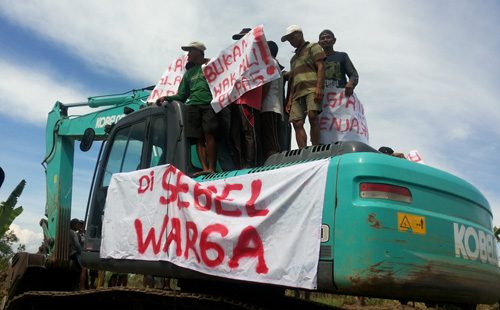
This village is located on the southern coast of Kulonprogo Regency, precisely to the east of Glagah Beach. Occupying 6 hamlets, the residents work as coastal farmers, planting chilies, watermelons and vegetables on coastal land which is more often referred to as Paku Alam Ground (PAG). This land is often the subject of disputes between residents and the state. The reason is, for decades residents have been working on the land, changing it from barren, dry and barren idle land to the green land it is today. However, even though they have been working on the land for decades, they have not received legalization for the status of the land they are working on. People call it, there is no "letter of approval" for the status of land workers. This happens because there is an exception to the land status in the Law
Agrarian Principles for several categories, including Sultan Ground (SG) and PAG in the DI Yogyakarta region. Residents actually hoped that the decades of cultivation could be the basis for the process of changing the status of the land into an object of rights. However, instead of a process that would please farmers, what emerged was a policy to use the land for a program that certainly threatened the existence of farmers. In the 90s, the government planned to build a golf course in the coastal area. This plan was opposed by residents who worked the sandy land because the project threatened their only source of livelihood. Finally, the plan to build the golf course was canceled and moved to another place. In 2004, the district government through the Village Head again launched a plan to use the coastal area for a transmigration area. The program called Transmigration Ring 1 will continue a similar program that has been running in Bugel village - a village next to Karangwuni village - which is provided as a relocation area for residents who were victims of the landslide disaster in the Menoreh Hills, northern Kulon Progo.
The government also promised to provide several housing plots for coastal farmers. However, residents rejected the government's plan, because what the residents needed was clarity of status, not houses as promised by the government. Residents pointed to the Bugel settlement abandoned by residents who moved from Menoreh, as evidence that the program was misdirected, did not involve the community and did not address the residents' primary needs. Currently, residents of the Karangwuni coastal area, together with residents of Karangsewu and Banaran villages - two other villages that are very likely to be affected by the Ring 1 transmigration program - are working together to fight for the confirmation of the status of tenant farmers and at the same time reject programs that marginalize farmers, including the Ring 1 Transmigration program.
At the end of May, residents held a hearing with the Kulon Progo District Government in the Banaran Village Multipurpose Room, attended by 350 sharecroppers. This hearing was intended to urge the District Government to immediately fulfill the need for PAG land legalization rather than prioritizing projects that would marginalize farmers. Unfortunately, during the meeting, the Regent, who had stated that he could attend, canceled his attendance and was only represented by the Assistant Regional Secretary. Therefore, until this note was written, the process of consolidating the network named the Coastal Community is still ongoing, and a series of activities to fight for the rights of sharecroppers are also ongoing.
Source: Field and workshop reports
BANARAN
“Yen anggarane cilik, kapan sehate balita?”
(If the budget is small, when will the toddler be healthy?)
-Comments from Sidorejo hamlet residents at the Advanced Farmers Group Meeting, May 15, 2004, in Sidorejo-
It may be surprising, but this is the fact about the small budget of integrated health posts in many villages, including in Banaran Village, Galur District, Kulonprogo. In 2002, the budget allocation from the Village Government was only 2500 per integrated health post per month. This amount was then increased in 2003 to Rp 10000,- per integrated health post per month.
With an estimated 40 toddlers per hamlet, each of them will receive a budget of Rp250- per month. What can you do with that little money? Mothers can only buy one fried tempeh or tofu for their toddlers. So, don't imagine toddlers getting a bowl of green bean porridge, let alone a glass of milk. On the other hand, the district government has not budgeted anything. there is a budget in question. He said, posyandu is a program from, by and for the community. So, it is natural for the community to participate in self-help for the implementation of posyandu.
This fact also shows how little government attention is realized through development programs and budgets that are intended to improve women's welfare. Adding to the long list of suffering of the community who cannot be involved in deciding budget policies, the impact felt by women and children is also getting heavier. Instead of getting benefits, what happens is the transfer of burdens and affairs, from the state to women's affairs.
So, what can women and the poor do to fight for their interests to be accommodated in budget policies? Holding meetings, formulating problems and preparing advocacy plans, and building dialogue with budget policy makers at both the village and district levels are some of the steps taken by the Tani Maju community, a group of farmers on the coast of Banaran Village, or better known as Pantai Trisik. As a result, for 2004, the Village Government will increase the budget allocation for integrated health posts to Rp 20,000 per integrated health post per month. In addition, the Village Government will also increase the allocation of funds that will be managed by the hamlet for the development of specific hamlet needs, and will cut budget items that do not support improving the welfare of residents. According to Teguh, a Sidorejo resident, this is a new and valuable experience for him. According to him, "...Lagi saiki diundang ngrembug kebutuhan Anggaran masyarakat karo Pemdes lan BPD" (Only now are we invited to discuss the needs of the community's budget by the Village Government and BPD). Hopefully, this process can continue to realize a participatory and community-oriented budget policy.
Source: field and workshop reports
WONOLELO
"The officials in my sub-district never tell me about the budgets in the sub-district"
"The hamlet head is kind to the residents, but not transparent about managing money"
-Recording of the Bantul Budget Advocacy Training process, Parangtritis, 16-18 April 2004-
Have you ever known how much budget is managed by the government? Even if this question is asked to the public, we might find answers similar to the above. This shows that openness and transparency of the budget are still something that is difficult to find. The same thing also happened in Wonolelo village, Pleret sub-district, Bantul Regency.
Wonolelo is one of the impoverished villages in Bantul Regency. Located on the eastern side of Bantul Regency, this village borders directly with Dlingo sub-district. Like other limestone mountain areas, the problem of minimal public facilities and infrastructure, low education and clean water are some of the main problems of this village. This condition is further exacerbated by the lack of transparency in the governance process and minimal community participation. As a result, basic community problems are often forgotten and untouched by development.
One of the basic problems is the issue of clean water. Although for years the residents have had difficulty in getting clean water, there was no budget and program that reached the community to solve the problem. Finally, in mid-2002, residents of Ploso hamlet who were members of the Ngudi Mulyo Group, submitted a proposal to build a reservoir and clean water channels to households. With this proposal, the residents hoped that they would no longer have to struggle to walk far down the steep limestone hill to get a sack of water from the spring to the east of the village. This proposal was submitted to the Regency and Provincial Governments through the Kimpraswil Service and to the DPRD.
This proposal was obtained after they formulated the basic needs of the residents. To strengthen the proposal, the residents completed it with a village map, the number of families who need clean water facilities, the material needs for the construction of clean water facilities, and the water discharge from the spring proposed by the residents. To measure the water discharge, the residents used oil jerrycans which were calculated per second to find out the water discharge from the spring. This proposal was also equipped with a budget calculation that was considered adequate for the needs. Finally, the residents' proposal was fulfilled by the government with a budget disbursement of Rp 300 million, and the residents' need for clean water was met.
At the village level, the issue of village budget transparency is also on the agenda of community groups that are members of the Ngudi Mulyo and Ngudi Makmur Groups. Starting from community discussion activities in two hamlets, namely Cegokan and Wonolelo, the process of criticizing the village budget then also involved other hamlets in Wonolelo village. One of the interesting findings revealed from this process was in criticizing the LPJ APBDes Wonolelo 2003. Residents noted several problems that they found, including:
- In the budget there is a budget for the construction of the Cegokan hamlet road of Rp 8,750,000. However, according to residents' calculations, the funds that came down were not that much.
- The case is also the same for the Cegokan bankruptcies amounting to Rp. 27,000,000
- Water withdrawal from Delingo has not been realized
- There is no budget breakdown for the village hall renovation, and only the roof tiles are being renovated.
These are some of the notes that they then submitted to both the Village Government and the BPD, and residents asked for the LPJ to be revised so that all money can be accounted for to the public. For the community, encouraging transparency is very important. Little or much, the people's money must still be accounted for.
Women Can Speak Differently
It is good to get rid of the assumption that village women are identical with a submissive attitude, not critical, and unable to speak up. If we ever attend a meeting of the Women's Communication Forum (FKP) Cegokan, we will see their spontaneity and openness when discussing the social problems they find. Just listen to their comments about the performance of government services;
“I had my injections at the midwife's every three months, paid Rp 10,000,- But, it kept failing. So, I got pregnant again”
"Forget about providing milk for toddlers, there's no money to even make posyandu green bean porridge"
"I've been selling vegetables for years, but it hasn't gotten any bigger. Is there attention from the government? Yeah, none. Everyone works on their own."
This new group - established in April 2004 - also formulated actions that were then carried out in advocating for the issue. Analyzing the problem, pouring it into attitudes and proposals, and building dialogue with officials or related agencies. The proposals were short and simple, as is, but quite substantial. Understandably, they are not women from the educated class. The majority are elementary school educated, some are housewives and some are vegetable traders around the village. That is a picture of poor hamlet women who are included in the Wonolelo village area, Pleret sub-district, Bantul Regency, DI Yogyakarta.
As a result, in July 2004, the government disbursed Rp 22 million in soft loans to women small traders who were members of FKP. In addition, the government through the Health Center also disbursed all funds for the elderly posyandu amounting to Rp 50,000 per month. Previously, Posyandu only received Rp 10,000 per month, without receiving information about the allocation of other funds. Another policy that is also very important is the provision of free family planning services (spiral and implants) to 26 women in Cegokan.
However, this achievement was not without obstacles. Previously, the Sub-district and Health Center, who felt they had been stepped over and had their faces tarnished, responded negatively to the residents' efforts. Ms. Kamti, the head of FKP, recounted the difficult times she went through when she was asked to meet the Sub-district Head. For three hours, she was asked alone to explain what this group of village women wanted, who they were, and whether there were any outside parties riding on this group. For a village woman, this process is more appropriately called an interrogation than a dialogue. She admitted to experiencing mental pressure and trauma for some time after the incident.
However, she did not give up hope. She invited the mothers back, who now cover almost all the hamlets in Wonolelo village, as well as several surrounding villages. She told them about the experience and invited them to find a way out together. Pros and cons, enthusiasm and fear and hope colored the meeting. Even so, the forum agreed to invite the government to have a dialogue with the women's group. Finally, some time after the dialogue, several of the above policies were issued by the government. Although small in terms of nominal funds, the benefits for them were enormous. This experience also taught that every woman has the right to speak up, especially when it concerns women's affairs. And, this can be done if women unite and organize.
Source: Field and workshop reports
Seloharjo
Located in Bantul Regency, Seloharjo is one of the poorest villages in Pundong District, with physical facilities that are not sufficient for all the needs of the villagers. Geographically, this village is divided into two areas; the lowlands along the Opak River and the hilly areas behind it. Bordering Selopamioro, Imogiri District, this village is inhabited by residents who mostly work as construction workers, sugar cane plantation workers, pedicab drivers, street vendors and sand miners. The population is spread across 16 hamlets with 40 to 55 poor families per hamlet.
Like rural residents in the southern region of Yogyakarta, Seloharjo residents must survive on dry land fed by rain. The scarcity of water sources and the absence of clean water facilities, residents rely heavily on the water of the Opak River and springs whose quantity and discharge are very limited.
Since May 2004, IDEA has been working in Seloharjo with residents of Dermojurang and Karangasem hamlets. As the subject area of the program that was the first to come into contact with IDEA, the residents of Dermojurang and Karangasem have just begun to organize themselves to work collectively to find solutions to problems of basic needs and rights through the regional budget.
Source: Field report
Selopamioro
Jetis Hamlet. Located on the edge of the Oya River, Jetis Hamlet is flanked by limestone hills and rivers. The topography of this hamlet is hilly and difficult to conquer. To build houses, residents must break rocks and clear the hills. Dry land and scarce water sources force most of the residents of Jetis Hamlet to work outside the agricultural sector as construction workers. As a result, there are very few male residents living in the hamlet.
To meet the need for clean water, Jetis residents try to channel water from sources that are quite far from the settlement. However, it is still far from sufficient because the water discharge is indeed very low. The same difficulties are experienced by residents who want to work on agricultural land - some on leased land - because agricultural water sources can only be obtained by drawing from the river and carrying it to the fields in the hills along the river. The donation of a water pump from a local political party figure is not able to serve all Jetis farmers because its operation can only be carried out by one of the village officials who lives in Jetis.
Kedungjati Hamlet. Located in the eastern corner of Selopamioro village, and directly adjacent to Playen sub-district, Gunungkidul, Kedungjati hamlet can only be reached via a 1.5 meter wide footpath. The road, which was just completed a year ago, is “attached” to the cliff along the river and cannot be passed by four-wheeled vehicles.
Occupying 4 RTs, 126 families living in Jetis have not received adequate electricity even though they have spent money to get a distribution connection. Most of its residents do not depend on the agricultural sector for their livelihood but work as construction workers. There is no irrigation at all for agricultural land, except waiting for rain. In such conditions, most of the male population works as construction workers.
Munthuk
Nglingseng Hamlet. Located on the east side of Munthuk village, Nglingseng hamlet is inhabited by residents who mostly work as dry land farmers and bamboo craft makers. With the highest education of the population on average elementary school, the residents of this hamlet are the largest recipients of rice rations for the poor (raskin), even though the criteria are determined inconsistently by the village apparatus.
Like their neighbors in Selopamioro, some Nglingseng residents also receive government rice for the poor (raskin). The quota for 36 families is divided equally among 108 families so that each family's quota becomes 3 kg per month at a cost of Rp 5,000.
Despite the limitations here and there, residents still have to bear the burden of road construction independently; in RT 5 each family is burdened with Rp 160,000 and Rp 100,000. Meanwhile, residents of RT 6 are burdened even more, Rp 200,000 and Rp 400,000 per family. That does not include the procurement of 3 kilometers of road sleepers and feeding the rented grinding machine operators from the Kimpraswil Service.
Even though there are accessible water sources, some residents rely on rainwater harvesting. Water reservoirs from springs have not been built to meet the need for clean water. Meanwhile, for agriculture, residents rely on rainwater. Nglingseng residents, together with Tangkil, are the largest recipients of social safety net funds for health (JPKM, health card).
Seropan I Hamlet. This area is inhabited by 125 families with 46 poor families. The clean water problem is quite serious because of the very minimal availability. Residents get it through plastic hoses that connect very low-flow water sources to collective reservoirs.
The residents, some of whom work as bamboo weavers, face health, clean water and population administration issues. The Raskin quota, which should have been for 46 families, was only distributed to 36 families. Finally, they agreed to divide the quota for 46 families who were entitled to receive Raskin.
Farmers in Seropan I rely heavily on rainfall to cultivate dry and thin land. They do have water pumps and pipes to raise water from the river, but their capacity is far from sufficient.
Source: field report
Together with the residents of Karangasem and Dermojurang (Seloharjo), Jetis and Kedungjati (Selopamioro), the residents of Nglingseng and Seropan I have been the subjects of the Village Community Group Advocacy Base Strengthening Program to Fight for Public Budget Policy since May 2004.
 English
 Bahasa Indonesia