

By: Wasingatu Zakiyah
The disbursement of poverty programs does not guarantee a decrease in poverty rates in Gunungkidul Regency. Since 2005, the poverty rate has been at 25.86, in 2008 it was at 25.96 (BPS Gunungkidul Regency). Although poverty reduction programs have been disbursed by various parties, this condition has not been able to significantly reduce poverty rates. Jamkesmas, BLT, Raskin, PKH, KUBE, Jamkesos, P2KP Package programs, etc.
The largest national poverty program that is currently the focus of the central government is PNPM Mandiri. It began with the Sub-district Development Program (PPK) which began since Indonesia experienced a multidimensional crisis and political change in 1998. The first phase of PPK (PPK I) began in 1998/1999-2002, PPK II was implemented in 2003-2006, PPK III early 2006-2007. Since 2008, it has changed its name to PNPM Mandiri which is planned to be implemented until 2015 according to the MDGs target. This program is funded by a World Bank Loan of US$ 744 million in PNPM financing.
Although there have been many poverty reduction programs, the poor are still at a high level. Many programs are labeled as poverty alleviation. In the past there were IDT JPS, etc., now there are PNPM Mandiri (PPK, P2KP, P2DT, etc.), raskin, BLT. These programs have not been integrated with existing programs in the regions. The planning process is also still fragmented. Some are purely planned by the Center, some are planned to be handed over to the regions. Efforts to provide capital assistance have been carried out with various schemes, but the funds that are disbursed are mostly used for consumption. A number of problems arise in providing funds to the community in the form of business capital. Capital assistance is not effective if given to groups. Assistance actually causes the community's social capital in the form of honesty and mutual cooperation to be eroded. Although a lot of assistance has been provided, the Government is considered less responsive in responding to the problems of residents who are experiencing economic difficulties. Farmers' means of production in the form of land are still very minimally owned by farmers. There have been no government efforts to protect residents' productive businesses from competition from large-capital entrepreneurs. The planning process for poverty programs (ad-hoc) has not been integrated with the regular planning process. Participatory planning processes always lose to political and technocratic ones. The planning process is mostly followed by women's groups. In several villages last year, the village Musrenbang was only attended by 2 women. Almost all facilitators were men. Sub-district delegations were also dominated by men.
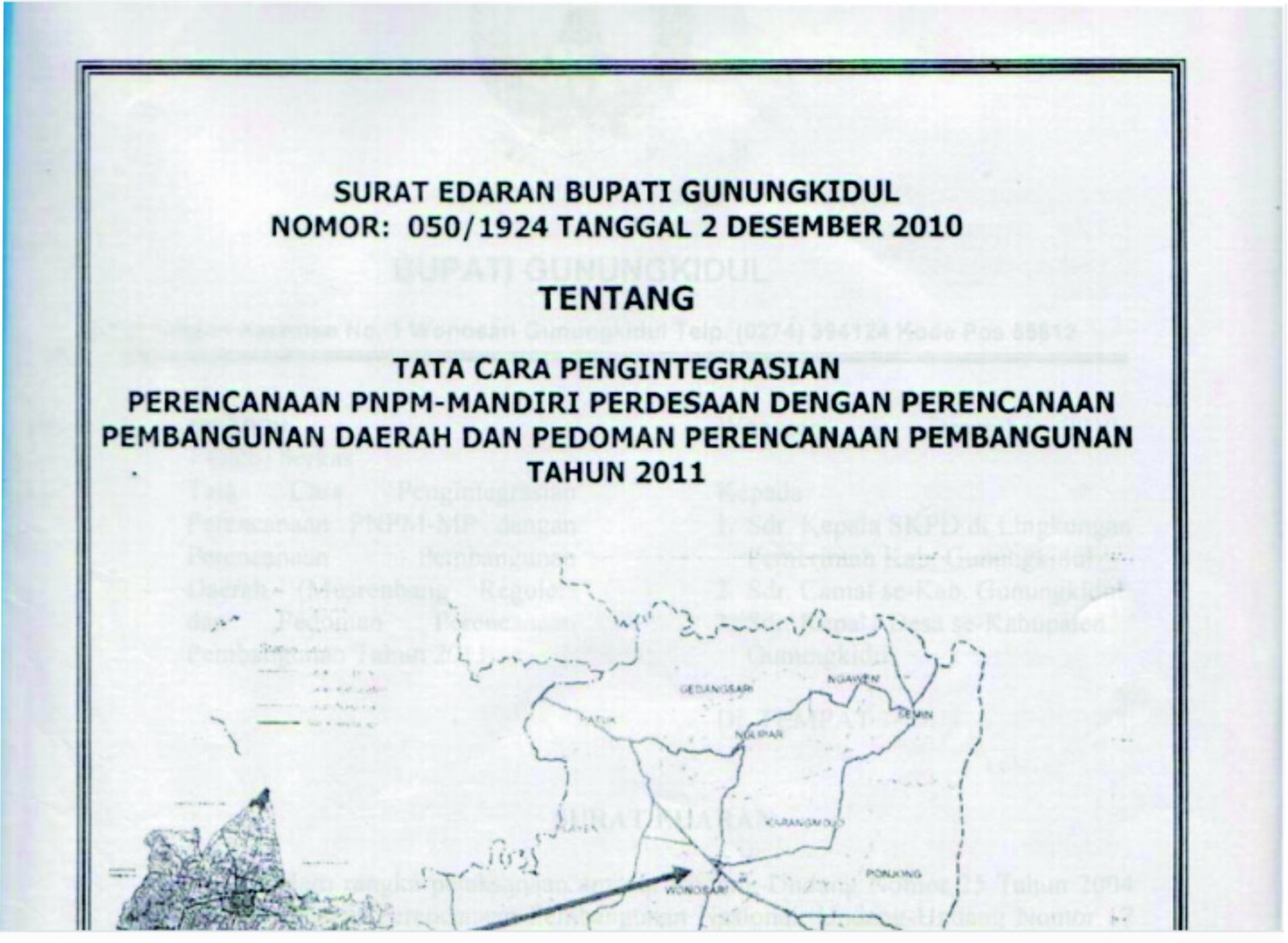
After more than ten years of running, it was realized that the PNPM program has its own planning and funding scheme that is separate from the government scheme. The planning process starting from initiating the village future (MMDD), Inter-Village Deliberation (MAD) and Village Deliberation (MD) runs alone without government control. Meanwhile, the planning process carried out by the government in accordance with Law 25 of 2005 runs without integrating the existing processes. The implementers of the development program and PNPM are also separate. Although they are in the same office and can coordinate, the pattern that has been built from the beginning between the regular development program and the PNPM program is completely separate. This is different from other programs that are integrated into the government scheme. Even the monitoring and evaluation process, PNPM has its own scheme. Restoring the role of the state in poverty reduction programs, especially independent PNPM, is very crucial. This pattern will restore the role of the state in fulfilling the rights of citizens. Efforts to integrate the regular and sectoral planning processes (such as PNPM) in Gunungkidul Regency are part of the technocratic process to restore the role of the state in poverty reduction efforts. Dialogue and joint discussion between the Government (Bappeda Gunungkidul Regency), the implementer of PNPM DIY province and the intermediary group (IDEA Association) bridged the integration process. This idea was institutionalized in the Circular of the Gunungkidul Regent Number 410/1813 dated December 16, 2009 concerning the integration of planning and began to be implemented in 2010.
 English
 Bahasa Indonesia