

ForewordThe journey of budget advocacy in Indonesia began with the rise of the anti-corruption movement, precisely since the start of the regional autonomy era in 2000. Corruption, which was initially centralized, also shifted to the provinces and districts/cities. Regional executive and parliamentary institutions became hotbeds of corruption. The fight against corruption was the initial agenda of budget advocacy activists, along with the implementation of fiscal decentralization. Furthermore, budget advocacy shifted to measuring budget allocations in fulfilling basic rights while encouraging a participatory, transparent, and accountable budgeting process. The book you are reading attempts to document the experiences of budget advocacy activists when dealing with various cases of corruption and poor regional budget management. The scope of experiences recorded in this manuscript is quite broad. The Seknas Fitra, Tiada Kata Cukup? (Seknas Fitra, Is There Never Enough?) report for example, shows that budget advocacy cannot be separated from aspects of regulations and legislation.
In another section, PATTIRO Malang shares their experience in encouraging the formation and implementation of regional budgets that are oriented towards fulfilling the basic rights of citizens, especially education. Their advocacy experience can be seen in the article Achieving the Right to Education Through BOSDA.
Fulfillment of the right to health is also the target of the budget advocacy movement. The urgency of this issue has absorbed many resources from civil society organizations, one of which is the Perkumpulan Inisiatif, Bandung. Their efforts to formulate a budget policy basis that guarantees access to affordable health services are stated in Sehat Itu Murah dan Mudah. The Regional Regulation on health insurance is expected to be a starting point so that health services for the poor are affordable and easily accessible.
Of the many health problems in Indonesia, women's and children's reproductive health is quite prominent. High maternal mortality rates, various cases of malnourished children (babies born with low birth weight) are the background to the health budget advocacy movement carried out by women's groups. The involvement of women in integrated service posts or better known as Posyandu has inspired PATTIRO Surakarta to answer the advocacy challenges in that sector. Their report is in the article Marrying the Role of Citizens and APBD Contributions in Posyandu.
Encouraging the role of marginalized groups in advocating for budgets in fulfilling their basic rights is also carried out by groups with disabilities (different abilities). SAPDA's efforts in Encouraging the Rise of the Disabled to Fight for Rights began to be realized from the advocacy process carried out in Yogyakarta.
Similar things were done by farmer groups organized by KSPPM in North Tapanuli Regency. In Indonesia, which is an agricultural country with a population that is mostly farmers, it is only right that farmers are more prosperous and receive adequate budget allocations to increase agricultural output. The article entitled Understanding the Budget Harvesting Welfare tells the story of farmers' efforts in advocating for agricultural budgets.
Fulfillment of socio-cultural economic rights as basic citizen rights through the budget is complemented by advocacy of the budget process for the fulfillment of civil and political rights. In the budget cycle that begins with planning, the bargaining position of civil society and marginalized groups will greatly influence the direction of budget policy. With the keywords participation, transparency, and accountability, improvements to the budget process are carried out by civil society elements.
Efforts to encourage the Institutionalization of Regional Budget Participation and Transparency were carried out by P3ML in Sumedang Regency. Through the Regional Planning and Budgeting Procedures Regulation, the idea of regional indicative ceilings and the Musrenbang Delegation Forum was stipulated in the Regulation. This Regulation became a reference for advocacy in many regions in Indonesia.
In addition to institutionalizing the budgeting process in a regulation, strengthening the budgeting process is also carried out by consolidating all elements of civil society in the region. Civil society networks become a force to influence regional budgets. Relevant experiences regarding this were written by FITRA Riau in the article Budget Reallocation Towards Effectiveness and Efficiency.
Encouraging pressure groups to fight for budget allocations that favor the people is very effective and moving. One of them is the experience of Lakpesdam NU which was recorded in When the People and Ulama Advocate for the Budget. Through Batsul Masail as a decision-making method for the ulama, budget problems were discussed and resolved. This experience in Cilacap Regency can be an effective model for other regions to strengthen advocacy.
In addition to encouraging religious groups to be involved in the budgeting process, several institutions that care about gender-responsive budgeting encourage women to participate in the budgeting process. They not only pursue a minimum quota of 30% for women in political participation but also create their own procedures to unite women in one voice through women's Musrenbang. IDEA's experience in the Meaninglessness of Participation Without Allocation is expected to be a model of participation with clear allocation.
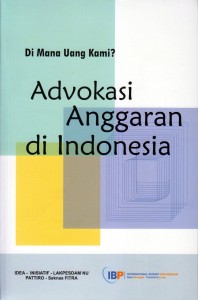
These various notes on the budget advocacy process are presented in the book entitled Where is Our Money? Budget Advocacy in Indonesia. The book, which is printed in two languages, is expected to provide a direct picture of the notes of budget advocates. We hope that the stories of success, failure, and changes contained in this manuscript can inspire readers in understanding budget advocacy in Indonesia.
The process of summarizing this story is one of the follow-ups to the meeting of five budget advocacy institutions (IDEA - Initiative - Lakpesdam NU - PATTIRO - Seknas FITRA). These five institutions are in the process with the support of the Partnership Initiative of the International Budget Partnership to provide an overview of the most significant changes in budget advocacy carried out in Indonesia.
It must be admitted that budget advocates who are enthusiastic in the process of advocacy are often in tatters in writing their experiences. However, the hard work of the authors to present and summarize their notes and memories deserves appreciation.
Our gratitude goes to the core team of the collaboration of 5 institutions, the authors, editors, and translators who have been in the process of presenting this book. Our special gratitude
Foreword
Budget Advocacy in Indonesia | vii
convey to Debbie Budlender - part of the Partnership Initiative support - who was very patient in providing advice and guiding with sharp questions during the preparation of this book. In addition, the International Budget Partnership team that has supported the writing process deserves our deepest gratitude.
We hope that this book can be a valuable contribution to budget advocacy in Indonesia and be an inspiration for other countries.
Yogyakarta, May 20, 2011
IDEA – Initiative – Lakpesdam – Pattiro – FITRA National Secretariat
 English
 Bahasa Indonesia
