
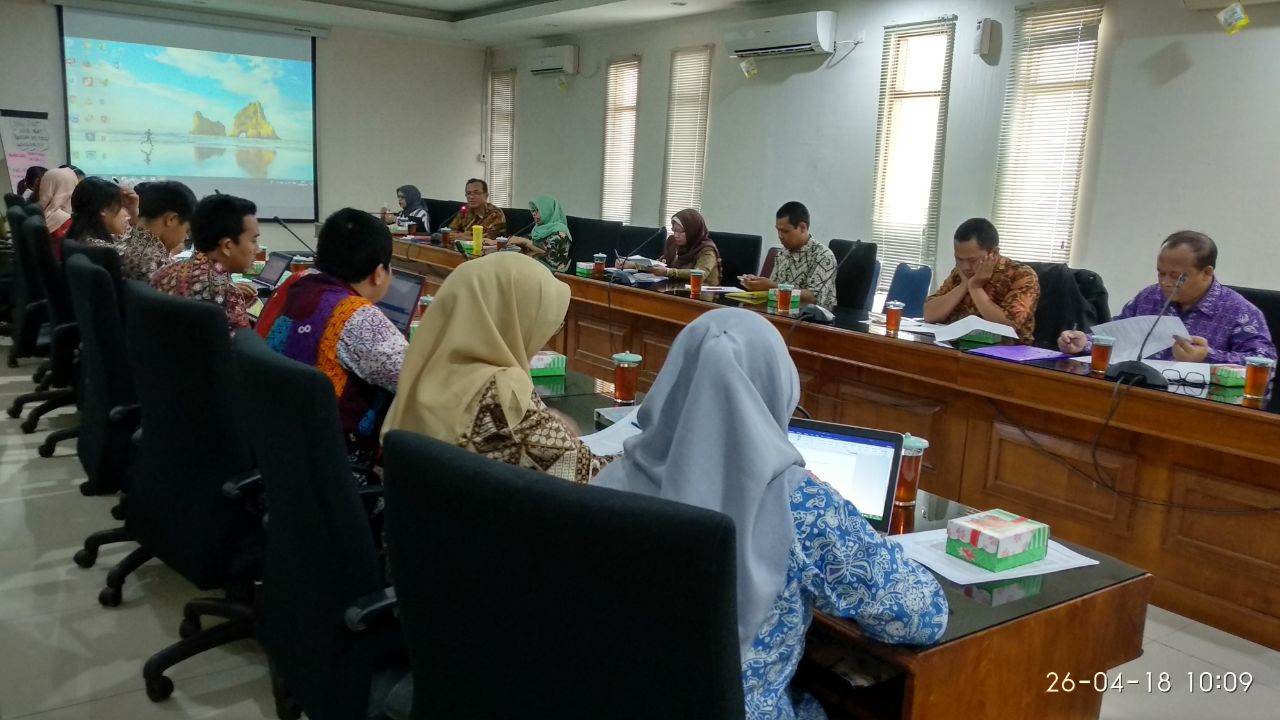

Yogyakarta, IDEA – To formulate the steps to be taken by the provincial government in realizing the poverty information system and the drafting of guidelines to realize the integration of one poverty data, IDEA Yogyakarta again held a coordination meeting with multi-party government ranks, Thursday (26/04) at the DIY Bappeda Office. The government ranks in question are from Bappeda and Dinsos DIY to the districts/cities within it. Previously, IDEA had also conducted similar coordination on Thursday, (29/04) at the Santika Hotel Yogyakarta.
Tenti Kurniawati, an activist from IDEA Yogyakarta, said that the purpose of today's meeting was a coordination meeting between IDEA Yogyakarta and the Regional Poverty Alleviation Coordination Team (TKPKD) to prepare a guide for one DIY poverty data.
"Today's meeting is a continuation of previous meetings. In 2018, it is hoped that the work of one poverty data will be more concrete and implement what was agreed upon together," said Tenti while opening the meeting.
Also read: Encourage Acceleration of DIY SIK Integration, IDEA Holds Coordination Meeting with Multi-Parties
According to IDEA Yogyakarta records, poverty is one of the issues that the DIY government is concerned about. The DIY Human Development Index (HDI) is classified as high. The life expectancy of its population is high, and the level of happiness of the DIY population is also classified as high. However, the number of poor people in DIY ranks 24th out of 34 provinces in Indonesia.
One of the things that explains the anomaly is the data. Lately, many people have argued that the BPS poverty indicators are no longer appropriate. Based on 14 indicators, only a few are still appropriate to the conditions of the community. The indicators of the ability to provide food, meet nutritional needs, provide clothing, housing, electricity, basic education, and fuel are considered no longer appropriate. Almost all residents of the Special Region of Yogyakarta have been able to meet these things. Only in terms of employment and savings ownership are there residents who cannot meet them. The problem is not only in the indicators, but non-compliance in the data collection process also occurs, so that residents who have been able to meet these needs are included in the list of poor people.
In this problem, the IDEA Association together with local governments at the DIY and district/city levels collaborated to carry out a series of activities to realize accurate poverty data quality. The data can be used to encourage poverty alleviation programs.
One of the achievements in the collaboration is the commitment of the DIY government and the districts/cities to realize one poverty data in DIY. The commitment was followed up with an agreement on the use of the 2015 BDT database and the integration of poverty information systems between DIY and the districts/cities. As a stage of the integration of the poverty information system, we intend to hold a coordination meeting with related parties to determine the right strategic steps in accelerating the integration of the poverty information system in DIY. This activity is a follow-up plan from the previous meeting, on Thursday, March 29, 2018 at the Shantika Hotel.
Also read: IDEA and Kulon Progo Regency Government Launch Kulon Progo Public Accountability Forum
Head of the DIY Planning and Development Agency (Bappeda), Abu, said that the poverty problem in DIY which is still 12.36% in the next 5 years is reduced to 7%, every year an average of 1% more. If intervened as usual it will only decrease by 0.5-0.6% per year.
"If accumulated from the plan in the RPJMD, it can only reduce 2.5%. One way to find out who is entitled to intervention is with data. While the data also changes in TNP2K and KEMENSOS, it does not run smoothly as desired. From TNP2K, poverty data moves to KEMENSOS so it changes. There are 25 types of PMKS, the data also varies," said Abu when giving a speech at the coordination meeting.
According to Abu, the initial data mechanism was already sweet, both from TNP2K and BDT 2016 have been submitted by the Ministry of Social Affairs. The Ministry of Social Affairs includes BDT in the Ministry of Social Affairs system, but Abu said, the Ministry of Social Affairs has another policy, the data basedate is added from data from the Ministry of Social Affairs. According to him, the 2015 BDT data was added to the KEMENSOS program data until it came out as Integrated PPFM Data.
"It turns out that the depth of data from TNP2K and data added from the Ministry of Social Affairs are not the same, not equivalent. On the other hand, regions must implement poverty intervention targets. While the data is still as described earlier. Now a lot has changed, the changes require updating. The updating mechanisms vary. From MPM, SIK-NG, simnangkis, etc.," said Abu.
Abu hopes that if today the SIK mechanism cannot be finalized, at least, according to him, it can provide an overview of the draft and its outline.
"Hopefully this Forum can produce a draft guideline and be refined in subsequent meetings so that the information system becomes even better, especially since each district/city already has a data collection information system, how can SIK-NG accommodate the systems that exist in the district/city," he hoped.
Meanwhile, Sigit from the Sleman Social Service, questioned the readiness of the DIY provincial government regarding the creation of a decree that regulates poverty data policies. Sigit also questioned the agreements that had been made in the previous coordination meeting. According to him, these agreements must be cleared so that further discussions are measurable and not in vain.
“I am disturbed by what we have agreed to. Is the province ready for the agreement at the Santika Hotel? The agreement, for example, is to create a poverty data decree. Is the agreement at Santika clear? If so, then what are the next steps? How do regencies/cities synchronize varivali data with SIK-NG data? This agreement needs to be cleared again, have the regencies/cities agreed? There are problems internally. For me, this must be resolved before going any further, so that it is not in vain,” said Sigit.
Responding to Sigit's criticism, Abu said that if the Province wants to intervene in poverty, the district poverty data follows the requirements of the province. For the Decree, for Abu, a Regent's Decree is also needed, if the intervention is legal, then it will use data verified by the district/city. If you want to intervene with verification, the Decree is needed by the district/city.
"The province hopes that what is being done will result in a regent's decree. The province will not make a policy if there is no legal basis. In 2018, poverty intervention must be stipulated by a regent's decree. Our friends in the districts/cities must go through this mechanism. So that we are legal. We must carry out interventions, BDTFFM data must be verified with district/city data," said Sigit.
Also read: Encouraging Village Transparency and Accountability, IDEA Initiates DAP
A different response was delivered by Indra Cahya from Bappeda Kulon Progo, according to him Kulon Progo did not use the Regent's Decree. He admitted that so far Kulon Progo has relied on the TNP2K's promise.
"2018 We do not have a Regent's Decree, we depend on the sweet promises of TNP2K. TNP2K promised that it would be available in December, and we were ready to issue a Decree, but it turns out that until today TNP2K has avoided going to the Ministry of Social Affairs. We do not have a Decree regarding the poverty data used. We have communicated with the Social Service to update the 2015 BDT data," said Indra.
Indra said the system in Kulonprogo has been integrated with TNP2K, shared with Dinsos and sent to KEMENSOS. SIK-NG, said Indra, was not like it is now. Before the new SIK-NG, Kulon Progo used the TNP2K system.
"We have to make changes so that the system can connect with SIK-NG," he said.
Responding to the discussion above, Wimbo from the Sleman Communication and Informatics Office has the view that Verivali should be in each region with its own methods. However, that does not mean that the province is letting go. According to Wimbo, it is the province that must provide the standard. Because, the standard, said Wimbo, is used as a benchmark in the district/city as a guide.
"There must be concrete steps. Integration, what data will be integrated must be determined first. With SIK-NG connected, that's a secondary matter. Collecting data is complicated. We are more tactical. The target data must be from one province," he said.
Wimbo further said that one data is determined by an indicator. If the data indicator is the same, any mechanism, according to Wimbo, can work. While the system, said Wimbo, will produce the same data.
"If the indicators/structures are the same, then the data can be communicated, then followed by the Regent's Decree. From the technical side, if you want to run from our experience in Sleman, the technicalities run first. The commitment is clear and don't take too long in planning, we will immediately talk about technical matters," he said.
Contributor/Editor: AH
 English
 Bahasa Indonesia