


The story of IDEA's long journey to obtain budget documents for the construction of the Malioboro street vendor relocation site at the former Indra Cinema in Yogyakarta.
The construction of a three-story building for the relocation of street vendors in the Malioboro area, Special Region of Yogyakarta, is suspected of being prone to irregularities. The Opentender.net site (hereinafter referred to as Open Tender), developed by Indonesia Corruption Watch, categorizes the construction of this Rp 62 billion building as the highest-risk project in Yogyakarta. This development is also ranked 8th in the most corruption-prone procurement nationally in the 2018 budget year.
Based on these indications, civil society organizations, one of which is IDEA, and a number of journalists collaborated to investigate alleged irregularities in this project. This collaboration was carried out after they attended the Goods and Services Procurement Supervision Training organized by ICW and the Government Goods/Services Procurement Policy Institute (LKPP) on 1-3 July 2019 in Yogyakarta.
Both parties share roles. Civil society organizations are tasked with obtaining auction documents from the Yogyakarta Provincial Government. Meanwhile, journalists will confirm these findings to relevant officials. The results of this collaboration will be published in their respective media.
The process of obtaining auction documents turned out to be a tortuous process. IDEA researcher Ahmad Hedar began the search for documents by meeting officials at the Procurement Service Unit (ULP) and the Public Works, Housing and Energy and Mineral Resources Agency (PUP-ESDM). This method was taken because IDEA and the government often form partnerships, for example in poverty alleviation programs. The meeting on July 24, 2019 gave Hedar hope. This is because the Head of the Cipta Karya Division of the PUP-ESDM Agency, Arief Azazie Zain, promised to provide a copy of the document within a week.
Two weeks later, Haedar's hopes were dashed. Arief said that the PUP-ESDM Service was unwilling to submit the auction documents. The reason was that the documents were not for the public. He referred to the Decree of the Minister of Public Works Number 451 of 2017 concerning the List of Excluded Information.
Haedar did not give up. He studied the regulation until he found a loophole. It turned out that the policy only regulated the list of information that was excluded at the central level, not at the regional level. On this basis, Haedar met Arief for the third time on August 9, 2019 and expressed his objection to the rejection. His reference was Law Number 14 of 2008 concerning Public Information Disclosure (UU KIP) which states that auction documents are not excluded documents. He also attached a number of jurisprudence of information dispute decisions that supported the statement. In fact, this method also reached a dead end.
Failing to use the friendly approach, Haedar wrote officially to the two agencies. Once again his efforts hit a dead end. They replied to IDEA's letter and remained adamant that the requested documents could not be opened to the public.
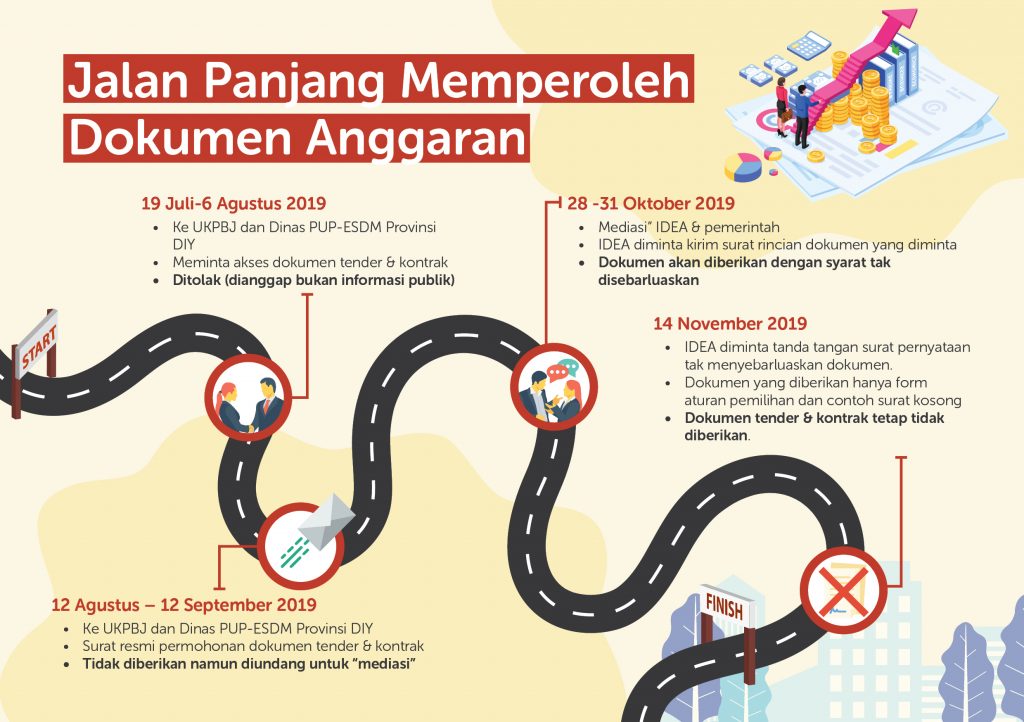
After IDEA submitted another letter of objection, the government responded. However, the Head of the Regional Infrastructure Development Bureau, the division that oversees the ULP, actually asked for 'mediation' with IDEA. In fact, said Haedar, the KIP Law does not regulate the mediation process when someone files an objection. "Their language is to be soft and smooth, and to obtain a win-win solution," said Haedar.
Haedar also met with the Assistant for Economy and Development of the Yogyakarta Provincial Secretariat and the Head of the Regional Infrastructure Development Bureau on October 28, 2019. Apparently, the 'mediation' in question was lobbying by these two officials so that Haedar would not insist on getting the tender documents. They objected to opening the tender documents on the grounds that they contained personal data of the company owner. Haedar felt this reason was odd. This is because the tender winner was working on a project that used public funds.
These officials eventually gave in. They finally agreed to hand over the documents with a number of conditions. For example, the documents were not to be disseminated and were only used for internal IDEA purposes. The results of this analysis must also be submitted to these officials. "They only ensure that the documents are not leaked," said Haedar.
At the end of the meeting, the officials asked IDEA to fill out a detailed list of required information. At first, Haedar was hesitant because he was worried that there were documents that had been missed. To get around this, Haedar and the IDEA team requested all tender documents from the planning stage to the handover.
On December 14, the two parties met again. At this meeting, several officials again warned Haedar that this document should only be used for internal research purposes and not be published. Haedar explained that IDEA would publish the results of the analysis if it found any irregularities. The two parties had some debate before the government finally agreed to provide the required documents.
They also insisted that IDEA sign a statement that points related to the prohibition of disseminating documents to other parties. The Regional Infrastructure Development Bureau also requires IDEA to submit the results of their analysis only to the Yogyakarta Provincial Government. "We ask that the last point be revised. Don't let it seem as if the analysis is only submitted to the government and not to others (the public)," concluded Haedar.
After opening the documents obtained, Haedar and friends were confused. The documents provided turned out to only contain a summary of the auction process and the rules in the bidding process. According to Haedar, they could actually get the information for free on the government website without going through the audience process. "We consider the document to be completely useless. There is no need to bother asking for the document," he said.
Haedar suspected that officials at the ULP suspected that they were monitoring the relocation project. Despite not having auction documents, the journalists still published their investigation articles. IDEA is committed to continuing to fight for open information for the public in Yogyakarta.
News source: https://antikorupsi.org/
 English
 Bahasa Indonesia