

It is very rare for a local government in Indonesia not to admit to a lack of funds. The centralized local tax regime that is not flexible enough to adjust the carrying capacity of the local economy has caused local governments to fail to build sustainable sources of Local Original Income. In fact, due to limited authority to collect taxes, the majority of governments rely on taxes and levies that burden the poor, namely health service fees. Meanwhile, the potential for taxes that have a redistributive effect on welfare are beyond the reach of local governments. The limitations of this local tax regime have made local governments strive so that their regions can as soon as possible - in other words, local governments are in a hurry - to extract natural resources from the contents of the earth.
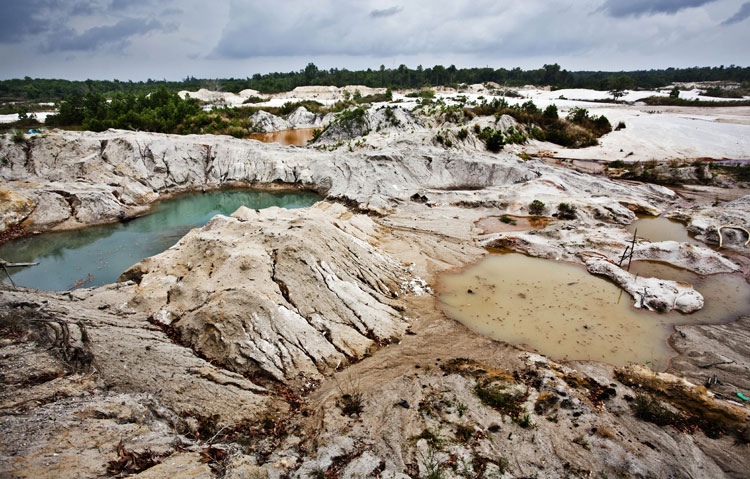
In southern Central Java, the Kulonprogo, Purworejo, and Cilacap regional governments have begun flirting with Australian investors to extract iron ore.In Kulonprogo, the local government insists on mining iron ore even though the implication is the eviction of agricultural land in ten villages. Until now, the conflict caused by this mining plan is still happening. Meanwhile, Kebumen Regency has long been trying to sell its karst mountains which are rich in cement raw materials. In southern East Java, such as Pacitan, Trenggalek, and Tulungagung, which are rich in tin and marble, extraction has increased since regional autonomy. The tin mining case in Pacitan shows that the local government does not monitor environmental quality standards so that a tin processing plant is deliberately built in the middle of the Grindulu River, whose water flows into densely populated urban areas.
Meanwhile, transfer funds from the central government to local governments for resource sharing are still always a problem. Local governments complain about the calculation of transfer funds that are not transparent and the late disbursement of funds, making it difficult to spend the regional budget. The failure of local government programs to be properly distributed is often solely due to transfer funds coming to the region towards the end of the budget year. This difficulty occurs not only in areas poor in natural resources but also in areas rich in natural resources.
In areas rich in natural resources, the curse of natural resources appears in the inability to accept revenue increases and poor spending orientation due to low participation, transparency, and accountability. Local governments that always lack PAD will rush to sign contracts with investors before preparing good governance of policies, institutions, and regional budgeting. Instead of bringing in PAD quickly, poor management makes revenue increases fail to improve people's welfare. We can point to the provinces that produce the most natural resources in Indonesia, such as Papua and Nanggroe Aceh Darussalam, which are respectively the provinces with the number one and number four poor people in Indonesia. (Admin)
 English
 Bahasa Indonesia