
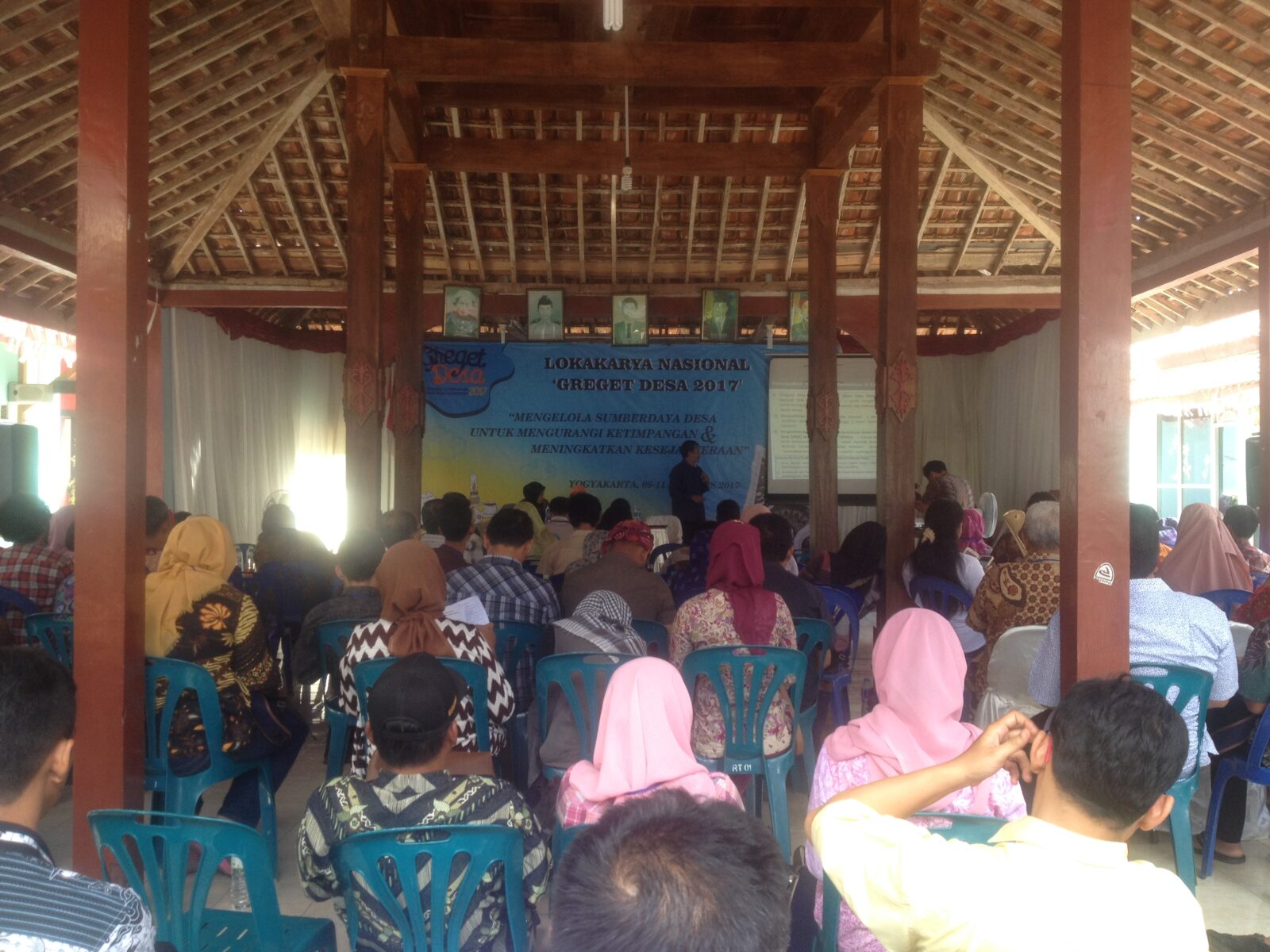

Discussion: The first session on the second day of the 2017 Greget Desa National Workshop carried the theme of "Regional Initiatives in Utilizing Poverty Information Systems". To discuss this theme, Greget Desa presented three speakers from various elements, including the Representative of the Gunung Kidul Regional Planning and Development Agency (BAPPEDA), Priyanto, Head of BAPPEDA Bantul Regency, Fenty Yusdayati, and Commissioner of the DIY Ombudsman Institution, Sutrisnowati. Each speaker presented different points to complete the construction of the theme being carried.
The discussion, moderated by Tenti Kurniawati, greeted participants with an invitation to discuss poverty in a more pleasant place than a hotel, namely in Dlingo Village.
Encouraging the Utilization of Village Information Systems
As the first speaker, Priyanto delivered material on the point of Integration of poverty information system which has been implemented in Gunung Kidul. Gunung Kidul started the integration by using Integrated Database (BDT). According to him, BDT is an extraordinarily complete data. However, not many people realize its advantages so that it is underutilized. Gunung Kidul took the initiative to combine it with national data that is already available.
According to Priyanto, "This data (BDT) is extraordinary, it has never been as complete as this. But unfortunately this data is not utilized. These are some of the variables in the BDT. This is very important and for planning even provincially or nationally. While other data with the same variables already exist nationally, this is also free and this is protected by confidentiality."
Through the Greget Desa 2017 discussion forum, Priyanto encouraged other villages to have an integrated village information system like in Gunung Kidul. Because the village information system has been provided with facilities by the central government, such as through the village domain.
"The village must have a village information system. The village information system has been generalized, all villages can create a village domain, the name of the village itself followed by the name of the sub-district, the name of the village-sub-district.desa.id." he asked
The Village Information System can have various useful functions. Among them are to realize the provision of public services such as mail services. In addition, it can also be a forum for citizen journalism that is able to market the potential of its region as happened in Gunungkidul. The Village Information System can certainly be used to manage data. Villages that have been given authority can record data on poor or non-poor people.
Open Data and Data Validity to Address Poverty
The next material presented by the Head of BAPPEDA Bantul Fenty discussed the topic of open data poverty. On Tuesday, August 8, 2017, Bantul just launched Open Data System and Poverty Information. Reducing poverty problems, there are many things that need to be done, one of which is by opening up data. Through open data system society can open all data that can be easily known. Such as information data on poverty programs implemented by the Bantul Regency Government complete with budget allocation.
"Open data is related to many things, open data is related to our program items and budgets, and which OPDs are implemented," he said.
He also reiterated that data accuracy is an important step to reduce poverty levels. So he reminded the discussion participants who also consisted of regional leaders to maintain the validity of data in their regions.
"So many things to regulate poverty, once again the right data will reduce poverty. Please, Mr. Regent, Mayor (local government) to handle this data."
Complaint Management for Optimal Public Services.
The last material delivered by Sutrisnowati discussed something that is no less important in the utilization of information systems, namely the management of public complaints. Poverty is always related to complaints. Until now, the management of public service complaints is still limited to suggestion boxes or short message services. Public service providers feel that their obligations have been fulfilled when they have provided such facilities. In fact, it is not certain that public complaints can be managed properly. This is not entirely true, according to Sutrisnowati, complaints need to be managed. Internal complaint management is an extraordinary mechanism, good management can lead to the point of success in the implementation of public services.
"If we talk about poverty, it is identical to complaints, if we talk about complaints, it is enough with a city of suggestions and SMS, photocopies and pasted. Complaints must be managed, internal complaints are an extraordinary tool.
The misconception that is still often considered wrong is the quantity of complaints. It needs to be understood together that the more complaints do not indicate that the service provider is bad. Conversely, the fewer complaint services do not reflect that the service provider is good. This is more or less related to the availability of facilities. For example, in Gunung Kidul, there are few complaints from the community to the DIY LOD, while from the city of Yogyakarta there are many. The Gunung Kidul community is certainly constrained by facilities (distance) to submit reports to the LOD, in contrast to the city community who can easily submit reports.
"The experience of the Ombudsment Institution in DIY, the most is in the City. The least is in Gunungkidul and Kulonprogo."
The Ins and Outs of Building a Village Information System
The discussion sparked enthusiasm from the participants, this was reflected through a question from one of the village heads from Magelang. He thought about how to organize a good village information system. Especially in the development process and the allocation of the origin of the budget allocation.
"What are the tips for local governments to implement SIDA in all regions, regulations, budgets and sanctions for regions that do not implement it?"
Priyanto who was given the opportunity by the moderator responded to this question interestingly. He told the conditions behind the success of Gunung Kidul in encouraging the implementation of a village information system that was not as easy as imagined. It took a lot of time to implement this, it required community participation and also assistance from universities.
“What I have explained is the beautiful story, if I tell the difficult story, they will not be interested. The information system was quite old in 2011, went viral in 2015/2016 and was born in Dlingo. In Gunungkidul it was quite fertile, in 2013 we replicated it in three sub-districts through PNPM but it was not optimal. In several other villages it became very difficult, when we think of data, we think of BDT data. But for villages, tools are needed, this is what we need to prepare. Assistance came from citizen journalism and in 2015-2016 (assisted) by UGM. The amount (of the budget) that was issued, we did not use the APBD but through the APBDes.. "
The first discussion ended with cheers led by the moderator to rekindle the spirit of the participants. After the discussion was closed, the participants continued the agenda for a lunch break and prepared for the next class discussion. (AH)
 English
 Bahasa Indonesia