
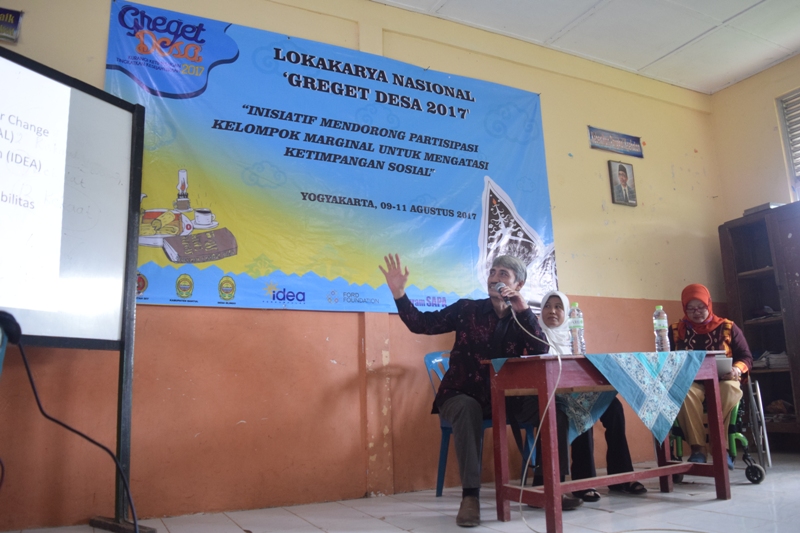

The afternoon discussion on the second day of Greget Desa 2017 carried a different concept from the previous discussion. The discussion was held with a panel mechanism, participants were divided into three different classes to discuss with each other for two sessions. Each class does have a different sub-theme, but still in one general theme in each session. For the first session, the general theme carried in the three classes was efforts to encourage citizen participation.
Resilient UMKM Management Post Merapi Eruption
Participants in the first class carried the discussion theme on the management of Resilient MSMEs Post-Merapi Eruption. Mart Widarto, as the moderator, opened the discussion by displaying graphs about the disaster that had caused the community's economy to slump. Jumadi from MSME Power Metal Magelang and Siti Mulyani, a representative of the Women, Children, Environmental Conservation, Micro Enterprises, and Agribusiness (PALUMA) organization were present to deliver their presentations.
Jumadi, shared his experience in establishing the UMKM Power Metal which initially only engaged in the sale of spare parts and gasoline. Its members consisted of 40 rural transportation workers (Angkudes). When the eruption occurred, they gained valuable experience about transportation needs during natural disasters. Power Metal saw this as a potential for running a business, so it took the initiative to become a transportation service provider in disaster-stricken areas.
“…From Power Metal began to take part in communication. If there is a disaster anywhere, from Power Metal can provide transportation. From the angkudes crew, they have joined the HT Merapi community…” said Jumadi.
However, not all disaster-affected communities can quickly turn problems into potential like Jumadi. This portrait is an experience told by Siti Mulyani when accompanying victims of the Merapi eruption in Kaliputih Village, Magelang Regency. Siti Mulyani actually found victims of the eruption in a state of severe stress because they lost their belongings. In fact, housewives were the ones who rose faster to overcome this problem. They had the initiative to create simple products to rebuild their household economy. Until now, there have been 10 MSMEs that have been assisted by PALUMA to obtain SP.IRT. Even to increase marketing, a culinary festival was held.
“…We held the Kaliputih culinary festival, as an event to restore the community’s self-confidence. There were many stands of their work during our time with them. We consider this festival a success. The community wants this festival to be continued…”
Good Practices in BUMDES Management
In relation to community products, in the second class a discussion was being held on good practices in managing Village-Owned Enterprises (BUMDes). The discussion, moderated by Farid Hardi, brought in speakers Budi Subariyadi from the Nglanggeran Village Tourism Manager, Gunungkidul Regency and Sutarjo, Head of Lestari Village, Kebumen Regency.
In his presentation, Budi conveyed the importance of the younger generation as a potential to build BUMDES. Like BUMDes which manages Nglanggeran Village tourism, it was initially built through the initiation of a youth movement in 1999. After Nglanggeran tourism became famous, the surrounding community was encouraged to utilize the potential that emerged such as through a home industry of chocolate processing.
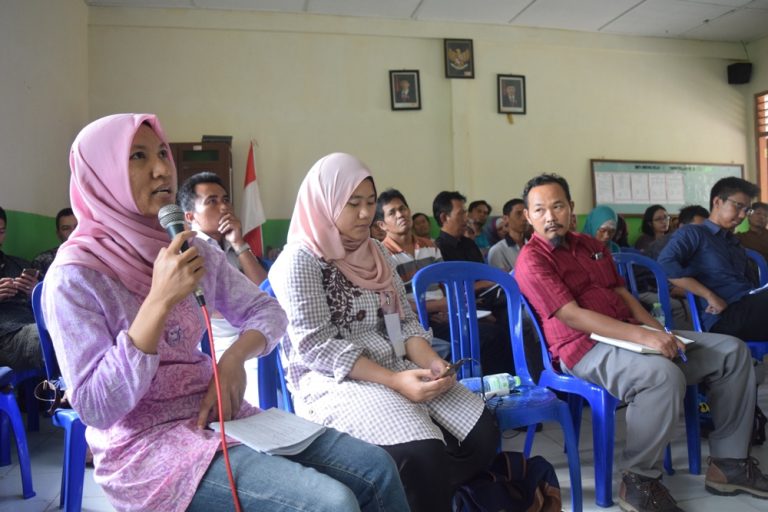
"... Nglanggeran Tourism was built through the initiation of a youth movement since 1999. In order to participate in the provincial competition and introduce tourism potential through a tree planting movement. After the emergence of existing tourism potentials, chocolate products from home industry processing began to be initiated," he said.
Not only the younger generation, even vulnerable groups are also encouraged to utilize potential. One of them is through goat farming. This vulnerable group consisting of former Indonesian Migrant Workers (TKI) has succeeded in creating an additional tourism package in the form of educational tourism on goat milk management.
"...Vulnerable groups such as former migrant workers are invited to build businesses such as goat farming. So that a knowledge tourism package for goat milk management is created...", concluded Budi.
Sutarjo added an important point about the BUMDES development mechanism that began with the formulation of Village Regulations. He emphasized that in BUMDES development, one should not only focus on asset distribution, but also remember a more important aspect, namely community empowerment.
According to Sutarjo, "the problem is only looking at the numbers but not looking at empowerment."
Initiatives to Encourage Participation of Marginalized Groups to Address Social Inequality
The third class focuses on discussing the sub-theme of community groups that need to be encouraged to participate in development. Moderated by Eko Budi M., this class discusses points about efforts to encourage vulnerable groups, especially people with disabilities, to overcome social inequality.
This sub-theme is based on the general condition that occurs, namely the lack of maximum involvement of disability groups in development planning. Development planning is a door to addressing social inequality. The first initiator Suryatiningsih Budi who comes from Handicap International clearly explains the various problems that plague people with disabilities. For example, the perspective that still places them not as the subject of development, but only as participants.
Worse still, many government programs treat people with disabilities only as recipients of assistance. This does not help but creates new problems.
"Still a government project/object, through programs that treat them only as aid recipients. The existing problems also arise from government policies that only provide life support, monotonous trainings...", he said.
The involvement of people with disabilities is very much needed in all forms of government policy formulation, because people with disabilities are also members of Indonesian society.
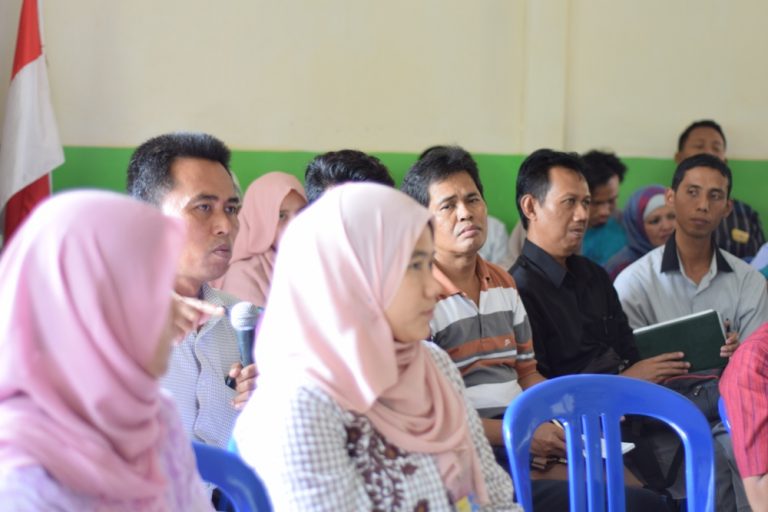
One of the factors that can encourage the participation of vulnerable groups such as people with disabilities is support from their living environment. Starting from the main family, the community that accepts them without discrimination and the local government that is open-minded to accept their opinions. This is what was felt by Mrs. Sumiyati, the second initiator of the Mutiara Ppembekan Disability Group.
"...I participated in community service, RT groups, Hamlet Deliberations and Village Level Deliberations. The Mutiara Ppembekan Group had the opportunity to propose needs such as capital and marketing for batik," he said.
Continuing the discussion of the group of people with disabilities, the third speaker Gardani from the Kadipaten Lestari group of people with disabilities conveyed several things that need to be considered in the governance of organizations of people with disabilities. In addition to general matters such as routine meetings, the formation of management structures, budget management, and establishing relationships. Routine meetings and inventory of member potential are important points that need to be considered. Routine meetings can maintain the hopes and goals that have been built by group members. Meanwhile, potential inventory can contribute to building member trust. This is like optimizing potential that is carried out on one of its members.
"..in Kadipaten there is a child named Yudi (mentally ill) who was asked to collect the electricity bill...", concluded Gardani.
After the discussion, each class took a short break before continuing the second session panel discussion. While taking a break, there were still several participants who continued their discussion in an informal atmosphere accompanied by a Coffee Break treat in the form of market snacks from Dlingo Village. (H)
 English
 Bahasa Indonesia