
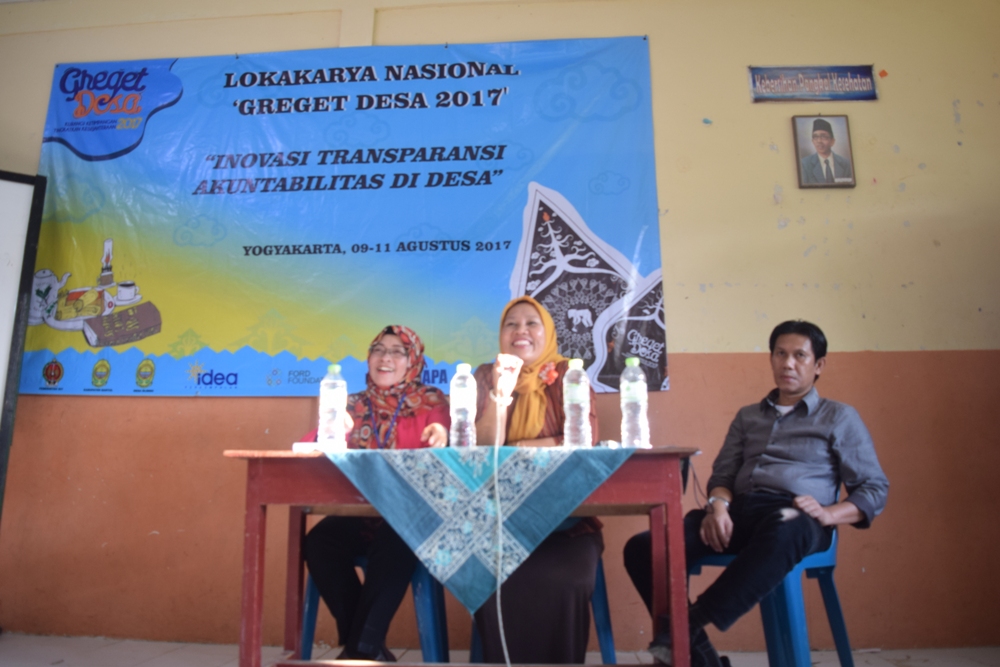

The 2017 Greget Desa National Workshop has entered its second day on Thursday, (08/17). Right at 15.00 WIB, the scheduled event is a class discussion session II. The main theme in the class discussion is Innovation Transparency Accountability. This series is a continuation of the previous class discussion that discussed a different theme.
In the class discussion session II, several core speakers were present, including from Prenggan Volunteers, I Am an Anti-Corruption Woman (SPAK), JMKP Kulon Progo, YPKM Makasar, and the SID management team of Girisuko village. They delivered materials in three different classes, attended by 35 participants in each class. This class discussion was delivered while interspersed with several games and sharing, so that the class atmosphere became more interactive.
Alimatul Qibtiyah, who was one of the speakers in the discussion of 'Initiating Transparency and Accountability Through Anti-Corruption Villages’ , told about her involvement in the anti-corruption movement with women which later became popularly known as SPAK. “I Am an Anti-Corruption Woman (SPAK) was founded in 2014 and eventually became a national movement. The activities are mostly in the form of games, both for kindergarten, elementary school and adults,” said Alim.
Then Alim conveyed his views regarding the high potential for corruption at the village level. According to him, there are many underlying problems that arise, one of which is weak review and monitoring. "Most corruption occurs when using the budget. This potential is prone to arise if the community does not come during the discussion and planning of the village APBD, plus there is no review and monitoring," explained Alim.
Alim emphasized that the potential for corruption in the village could arise from five things, namely during Planning, Procurement, Implementation, Accountability, Supervision and, monitoring. Therefore, to minimize the potential for corruption, said Alim, the community must get used to practicing the three Ls. "Remember the three Ls to eradicate corruption, See, Fight, and Report," said Alim while asking the class participants to imitate his words.
Social Audit Practices of Poverty Alleviation Programs
Meanwhile, in a different class with different materials and speakers, an important topic regarding the ‘Social Audit Practices of Poverty Alleviation Programs’ was also discussed. This discussion was started by a presentation by Rosmiyatun from JMKP. She said that the social audit practices she studied were related to assistance for poor students. According to Ros, this was due to findings in the field regarding the inequality of aid recipients.
In more detail, Ros revealed that his findings regarding the inequality of recipients of assistance for poor students emerged due to several problems, including, as expressed by Ros, the lack of socialization by the school, the lack of transparency by the school, participation only by the regional and central governments, inappropriate targeting, and the lack of involvement of civil society in the control process.
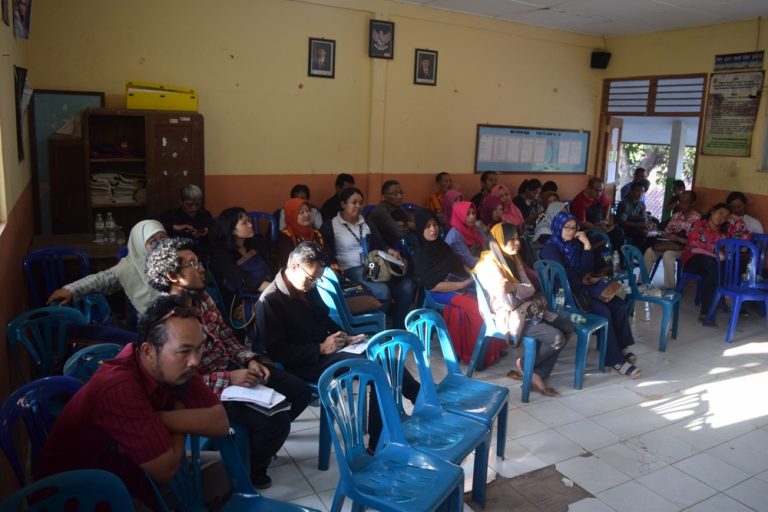
Regarding the efforts that can be made in relation to social audits to overcome poverty, Ros recommended several important steps that can be taken by activists and the government.
"We need to encourage the use of an integrated database, involve the participation of poor people, encourage poverty policy programs from villages to higher levels so that they do not overlap, provide information, encourage the government to increase capacity for the community, encourage monitoring meetings involving residents, held at least once a semester, encourage the lowest level government, namely the RT, and provide services that are easily accessible to the poor and can be followed up by the local government," concluded Ros.
BDT Update with AKP Method
An interesting discussion that was not missed was the technical issue of updating the Integrated Database (BDT) with the Participatory Poverty Analysis (AKP) method. In this discussion, there were two speakers who explained in detail the theme above. Both of them explained their understanding and experience gained while actively assisting the community.
Wahyu Setianingsih, one of the speakers of this discussion, shared her experience when she first practiced this method. She said that she had been in contact with the community since 9 years ago.
"I have been in frequent contact with the community since 2008. We were asked to talk about updating the database. Overall, poverty data is very different from reality. Many government programs are not on target. For example, direct cash assistance is mostly received by people with high economic levels. We are trying to collect data to identify the poor," said the woman who is familiarly called Wahyu.
Wahyu regretted the lack of public attention, especially village officials, to the chaotic data management. According to Wahyu, villages are sources of data, but poor in data. He finally took the initiative to take important steps together with village observers and government officials to improve the data management system.
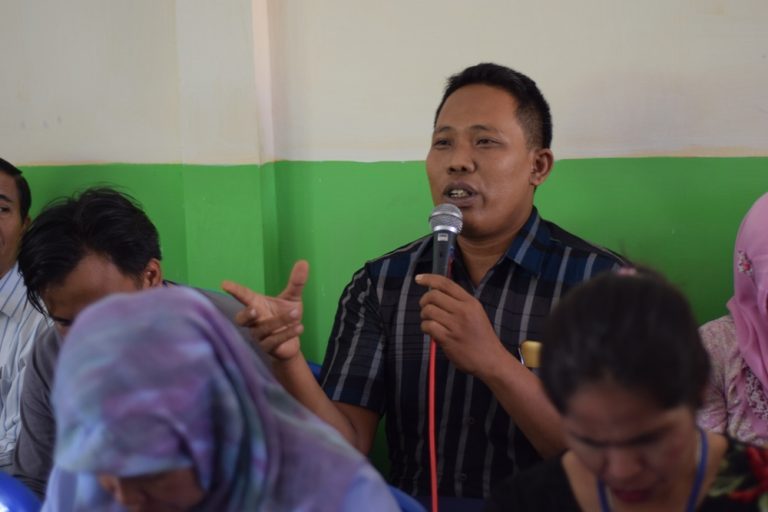
"In 2011, IDEA together with CRI and SAPA introduced us to the Village Information System. In 2015, we received full support from Bappeda Gunung Kidul, and we started to receive BDT. We were facilitated for workshops and trainings to verify and validate this BDT. Validating BDT data turned out to be very complicated, especially during re-registration," said Wahyu.
Furthermore, Wahyu reminded that in the data validation process, there are eight criteria in poverty data, which, said Wahyu, include permanent household status, changing households, moving households, changing heads of households, changing number of families, new poor households, and unknown households.
Meanwhile, Zakaria, another resource person in this discussion explained at the beginning that the causes of poverty are also influenced by environmental factors. People can suddenly become poor if their area is a flood pocket or endemic pocket. So, according to him, looking at the causes of poverty must be seen from four basic aspects such as, minimal environmental carrying capacity, minimal supporting capacity for increasing capabilities, powerlessness in fulfilling basic rights, and policy regulations that do not favor the poor.
To carry out poverty alleviation efforts, according to Wahyu, there are four things that can be done, including efforts in territorial/spatial-based participatory poverty studies, participatory poverty studies based on livelihoods, participatory poverty studies based on poor families and regulatory assessments.
"Musrenbang proposals are often based on desires, not needs. The characteristics of the poor, in a meeting forum, will not admit to being poor and will only wait to be proposed. This is why AKP is needed. We strive to include the voices of the poor in the discussion. AKP as an instrument to include the views of the poor," he said.
At the end of his presentation, Zakaria hoped that participants would expand their space when they intend to make changes. This is important, because according to Zakaria, space for change can emerge from many policy makers. "I hope that my friends do not only move at the village level. Because we want to open the government's eyes that our data is more precise. In order to be drawn to the Regency, the indicators must be the same. The village team is welcome to try to create precise data," he said. (AH)
 English
 Bahasa Indonesia