
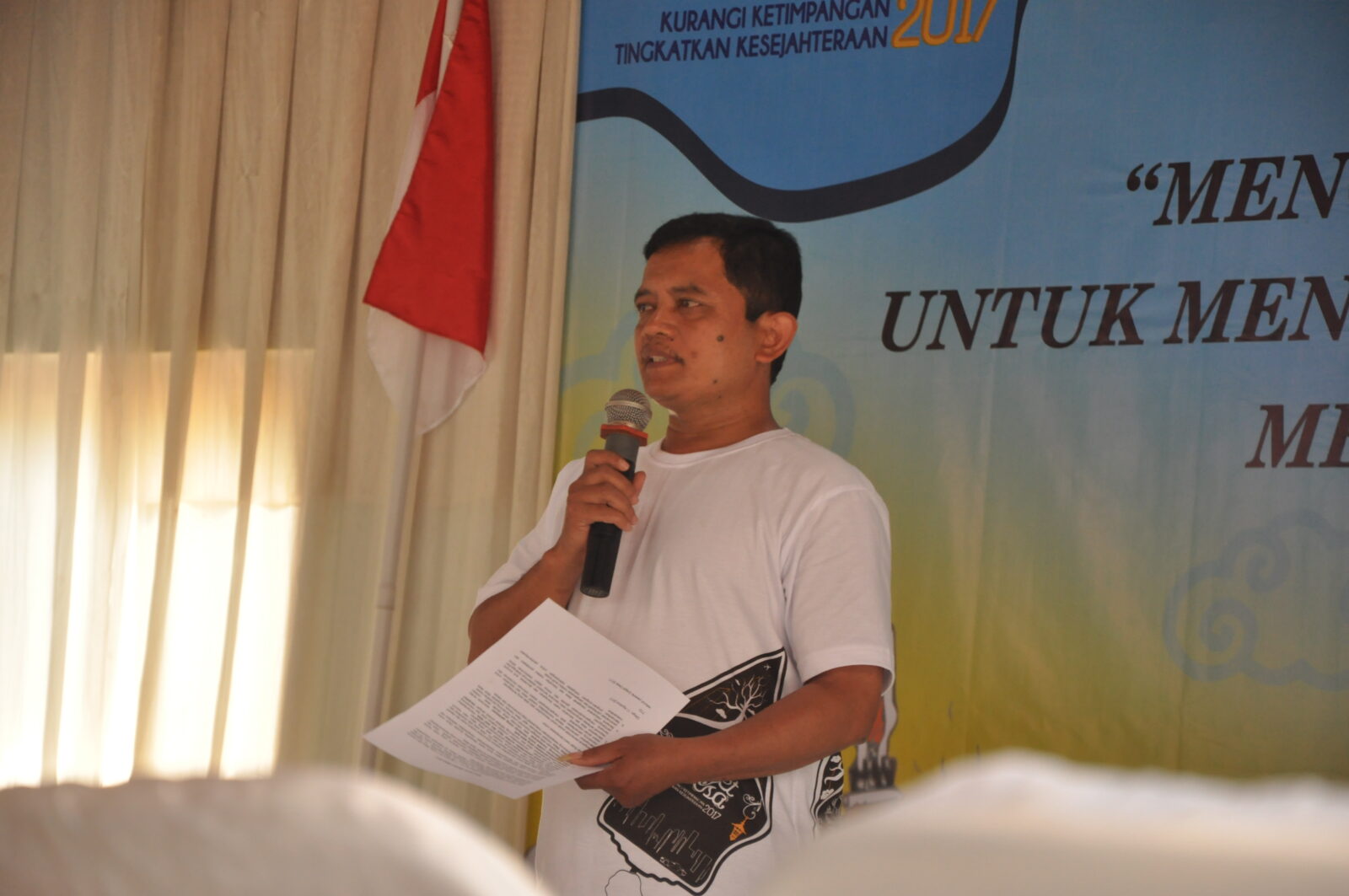

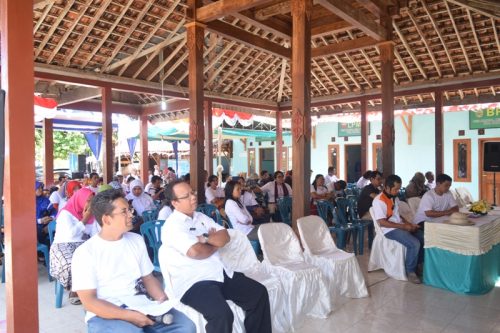
"After three days have passed, now Greget Desa 2017 has entered the final seconds of its implementation. Participants who have just returned from several tourist spots in the village, appear to be rushing to one place, the Dlingo Village Hall"
The 2017 National Workshop 'Greget Desa' was officially closed on Friday, (11/08/2017). The event, which was held by IDEA and directly supported by the Ford Foundation, the DIY and Bantul Governments, and the Dlingo Village Government, was entitled 'Reducing Inequality and Increasing Welfare'. After three days, the event was closed with remarks from the Head of Dlingo Village and the Representative of the Bantul Regent. In addition to the remarks, the closing of Greget Desa this time also produced several recommendations summarized in the 'Dlingo Declaration'. The declaration was read directly by the director of IDEA at the Dlingo Village Hall.
Bahrun Wardoyo, as the head of Dlingo Village, in his speech expressed his gratitude and apologies to all participants involved in the activities carried out for three days. He also gave his appreciation because the participants were willing to follow the activities from the beginning to the closing.
"This activity is truly extraordinary, I would like to thank you and all participants who have taken the time to attend and stay in our village, Dlingo Village. We are very proud and salute you, and clearly, as hosts, there must be many things that may disappoint you, the committee and all participants, both in terms of service and the homestay offerings. But really, that is the maximum effort we can give," said Bahrun.
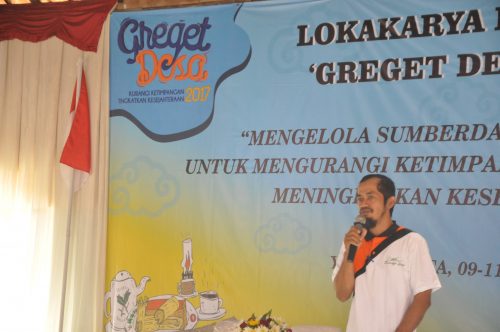
Furthermore, Bahrun also hopes that this activity can provide benefits and lessons to all parties, both the committee, the apparatus and the Village observers. Bahrun advised all participants to be able to take good things from Dlingo regarding Village management, especially related to BUMDES management. He is optimistic that one day all Villages can have a Village Mart.
"There are two programs in Desa Mart, namely supplier empowerment and distribution of small shop products. We hope, our dream, 70,000 villages throughout Indonesia have Desa Mart, so God willing, if all villages have Desa Mart, then our struggle to build Indonesia's economic distribution is over," Bahrun hoped.
Meanwhile, the representative of the Regent of Bantul, also expressed much appreciation for all participants involved in the Greget Desa event, especially the initiators who organized it. According to him, this event was very interesting because it could be a space for exchanging information related to the realization of the Village program in each district throughout Indonesia. On the other hand, according to him, this activity took place because of the good cooperation between the Village government, NGOs and the Regional government.
"We appreciate the hard work of our fellow organizers, both IDEA and the Dlingo Village government. During the three days of this event, we have heard a lot of information and success stories about the realization of Village activity programs in each district. This is an interesting marriage between us (the bureaucracy) who are struggling with poverty alleviation, with NGO friends who work in theoretical areas," he said.
He emphasized the importance of efforts by village officials and observers to find alternatives for poverty alleviation in each village. According to him, active NGO participation is also quite important to produce new efforts, both theoretically and practically. "We hope that the good practices presented yesterday will inspire village governments in other areas in poverty alleviation planning. Or for NGO friends to discuss alternative efforts for poverty alleviation programs amidst difficult external currents," he hoped.
Dlingo Declaration
One of the important parts in the closing of the 2017 “Greget Desa” national workshop was the birth of a monumental declaration containing many recommendations. The declaration read by the director of IDEA, Sunarja, also contained the commitment of the participants in the context of village governance. When read, the declaration initially contained reflective sentences related to the village situation.
"We realize that inequality is a national problem that is not only solved by the central government but involves local governments, villages and community groups. This effort is carried out with affirmative policies that prioritize vulnerable community groups to access village resources," said Sunarja.
Next, Sunarja read out the results of the implementation of the 2017 National Greget Desa Workshop. There were four important results that were read out in their entirety by Sunarja. The results include, first, the need for one data to ensure synchronization between the center and regions as well as between regional government organizations and K/L. The existing data is verified and validated by the Village to then become data referred to by all stakeholders and become the basis for planning and budgeting.
Second, revolutionizing the utilization of Village resources and assets, utilizing capital and social tools, maximizing local potential production and encouraging consumption, increasing purchasing power, encouraging product downstreaming by breaking down the order for better change. Third, there is a political commitment to open up space for participation of vulnerable groups and encourage transparency of information owned by the Village through easy access to data as an instrument to encourage social change. And the fourth is that Village accountability is a must so that the Village is able to manage Village funds to support community welfare for the fulfillment of citizen rights.
In addition to the results of the implementation, the declaration points read by Sunarja were related to the commitment of the participants involved in the Village Greget event, including officials, observers and the village government.
"On that basis, we agreed to, first, oversee the central government to realize one integrated data. Second, ensure that local governments facilitate village and sub-district initiatives to encourage asset utilization, develop poverty information systems and public complaint systems. Third , ensure that villages and sub-districts are increasingly transparent and accountable, anti-corruption, responsive to disaster risk reduction including disaster resilience, mainstream gender and inclusion in the entire development cycle. Fourth, together with the community, oversee villages and sub-districts through data collection and participatory planning and supervision through social audits. And fifth, ensure programs to address inequality for community empowerment," said Sunarja while being followed by participants at the Dlingo Village Hall.
The last five points read by Sunarja also became the conclusion of the entire Greget Desa 2017 event. Participants guided by the relevant committee then began to escort the participants to check out from the homestay and prepare to travel back to Yogyakarta. Participants who came from outside Yogyakarta returned with various vehicles, both private vehicles, and public vehicles such as planes, trains, and buses. (AH)
 English
 Bahasa Indonesia