

Openness of information is a necessity in the digital era like today. The rate of information exchange is so fast. The public calls all of this part of modernity. And we who live in this era are modern humans. Humans who are aware (or not) have depended most of their affairs on digital software.
In this modern world, public data and information that is intentionally covered up has begun to be abandoned. Several countries, such as the United Kingdom and the United States; have begun to open access to public data and information. Once again, public data and information. As long as the data and information published is public or meets the level of publicity, and is not state secret data or information, of course the state is obliged to provide the widest possible accessibility to the public. In addition, the state is obliged to carry out the process of disseminating public data and information, as part of the state's responsibility to the public. Unfortunately, local governments as part of the state institutional structure, are still paranoid about carrying out the process of opening up public data and information, especially those related to public performance, programs, and budgets. What is the valid evidence? It's easy. Please test the access to budget planning documents to the local government where you live/are domiciled. Wait and observe the response of the institution!
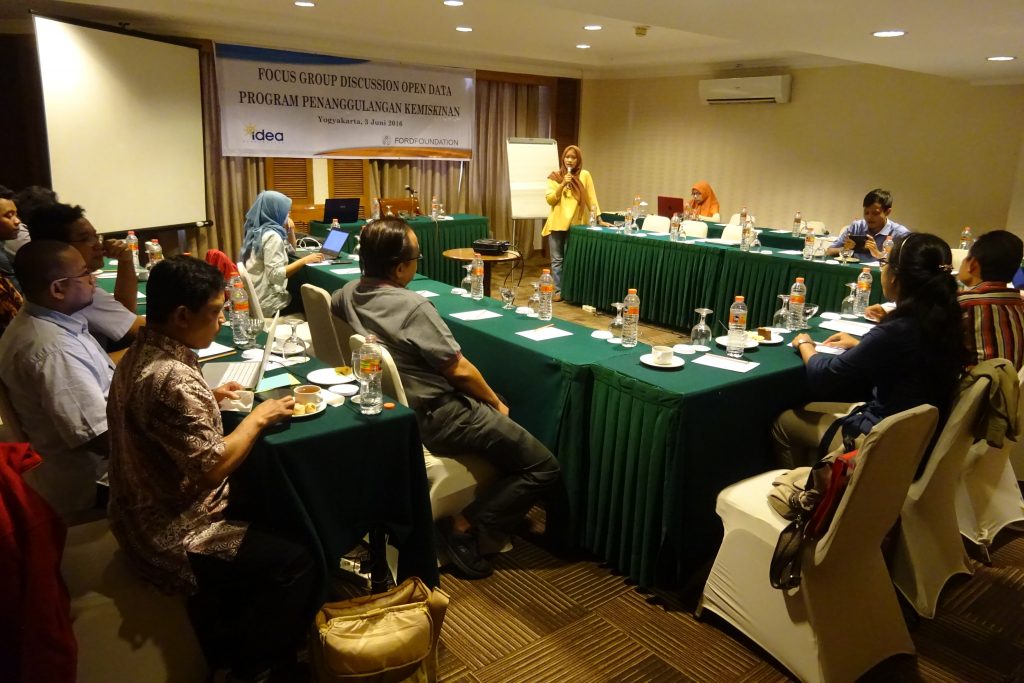
On June 3, 2016, IDEA as one of the institutions that has been encouraging and overseeing the openness of public data and information, especially those related to public budgets in Yogyakarta, held a Focus Group Discussion “Open Data Program for Poverty Alleviation in Yogyakarta”. This activity is the beginning of the Sub Program “Open Data Program for Poverty Alleviation”, and is fullysupported by the Ford Foundation for the next 2 (two) years. The activities of the Sub Program “Open Data Program for Poverty Alleviation” above are integrated into a main program entitled “Developing Transparency of Village Information Systems (SID) and Community-Based Monitoring Systems Using New Technology to Monitor the Implementation of Program Development”. This main program itself is a joint program between IDEA Yogyakarta and the Ford Foundation.
The FGD activity “Open Data Poverty Alleviation Program in Yogyakarta” was held for a full day, and involved government elements (TKPKD) in 4 districts, 1 city, and 1 province; as well as several representatives from non-governmental organizations (NGOs). Through this forum, IDEA wants to brainstorm regarding the concept, visualization, and implementation of “open data” to all participants who attended. “Some of the benefits related to “open data”, the first is about transparency and accountability”, explained Bambang Heri, one of the speakers who had “ngangsu kawruh” “open data” in the Philippines. “Secondly, the community is helped by the presence of open data so that they can compare the level of performance of one government with another”, continued Pak Be, Bambang Heri’s nickname. In line with Pak Be’s presentation, Yoga Putra who was assigned by IDEA to oversee this “open data” program said, “Implementing open data for poverty alleviation programs means encouraging (also) the government to carry out public accountability.” "After open data is implemented, the next thing we need to push together is public awareness to participate in monitoring government programs and performance," he added. Several representatives from government elements also agreed with the speaker's explanation. "After reading the presentation on open data, the government actually agrees with the concept and implementation of open data," said a Muslim representative of the Yogyakarta City TKPKD.
With this brainstorm about “open data”, it is hoped that there will be a common perception that is built together, both between the government and civil society. Moreover, Open data is an inevitability that can no longer be avoided, let alone rejected. The initiation of “open data” by the government must start now, as a manifestation of public accountability and the moral responsibility of the government as an institution. On the other hand, the initiation of “open data” will provide broad access, as well as opportunities, for the public to be actively involved in monitoring/supervising government programs and performance. That way, good governance is no longer just a figment of the imagination, just a utopian concept that exists in the lecture books of political science and government students. “Open data” becomes a medium of consensus between the government and society to create good governance. [YPP, LWB]
 English
 Bahasa Indonesia