

From year to year, the number of poor people in Indonesia shows a decreasing trend, although not too significant. In fact, the state budget that has been spent on poverty alleviation programs is already countless. Perhaps tens, or even hundreds of trillions, the government has allocated its budget for poverty alleviation programs. With a relatively large public budget allocation, it is only natural that the number of poor people in Indonesia can be reduced (very) significantly.
There are 2 (two) interesting theses that can frame our logical thinking in understanding the relationship between poverty figures and the size of the public budget posture for poverty alleviation programs. The first thesis, the lack of disaggregated data related to poverty alleviation program interventions at all administrative levels, starting from the central government, provinces, districts/cities, and villages. The minimal availability of disaggregated data makes poverty alleviation program interventions less than optimal. We often hear about inaccurate target benefits in society. The benefits or beneficiaries of poverty alleviation programs that have been previously projected by the government are not fully utilized by the community. Of course, the public can definitely guess the final result, Indonesia's poverty rate tends to be "stable" from year to year, and from president to president.
The second thesis, poverty alleviation programs in Indonesia that have been attempted by the government, at various administrative levels, are not yet fully transparent and accountable. In fact, we can witness this condition with the naked eye. The dissemination of information about poverty alleviation programs that are the responsibility of the government, is not optimal. In society, what is called information asymmetry occurs, due to the process of information dissemination that is not optimal. Not to mention, public accessibility in reaching poverty alleviation program data is quite minimal. The minimal public accessibility to poverty alleviation program data is most likely caused by 2 (two) things. First, it is indeed (intentionally) limited by the government as the legitimate owner of poverty alleviation program data, and second, the lack of public awareness in accessing poverty alleviation program data, as part of the public monitoring/supervision scheme of government service performance related to poverty. Accessibility of information for the public related to poverty alleviation programs is a must, if not to say an obligation.
One of the efforts to provide public information accessibility about poverty alleviation data and programs is by opening up fairly detailed information accessibility about poverty alleviation program data at every administrative level. So, how do we encourage open access to this information? The way is by trying to implement open data, or in popular terms called "open data", poverty alleviation programs at every administrative level. Encouraging one to two government institutions at the local level to start the "open data" process as an initial pilot, is certainly one of the best choices. The hope is that the implementation of the "open data" process for poverty alleviation programs can run optimally so that it can be replicated by other government institutions. Although it is quite difficult to encourage the government to make this effort, this initiative must still be started.
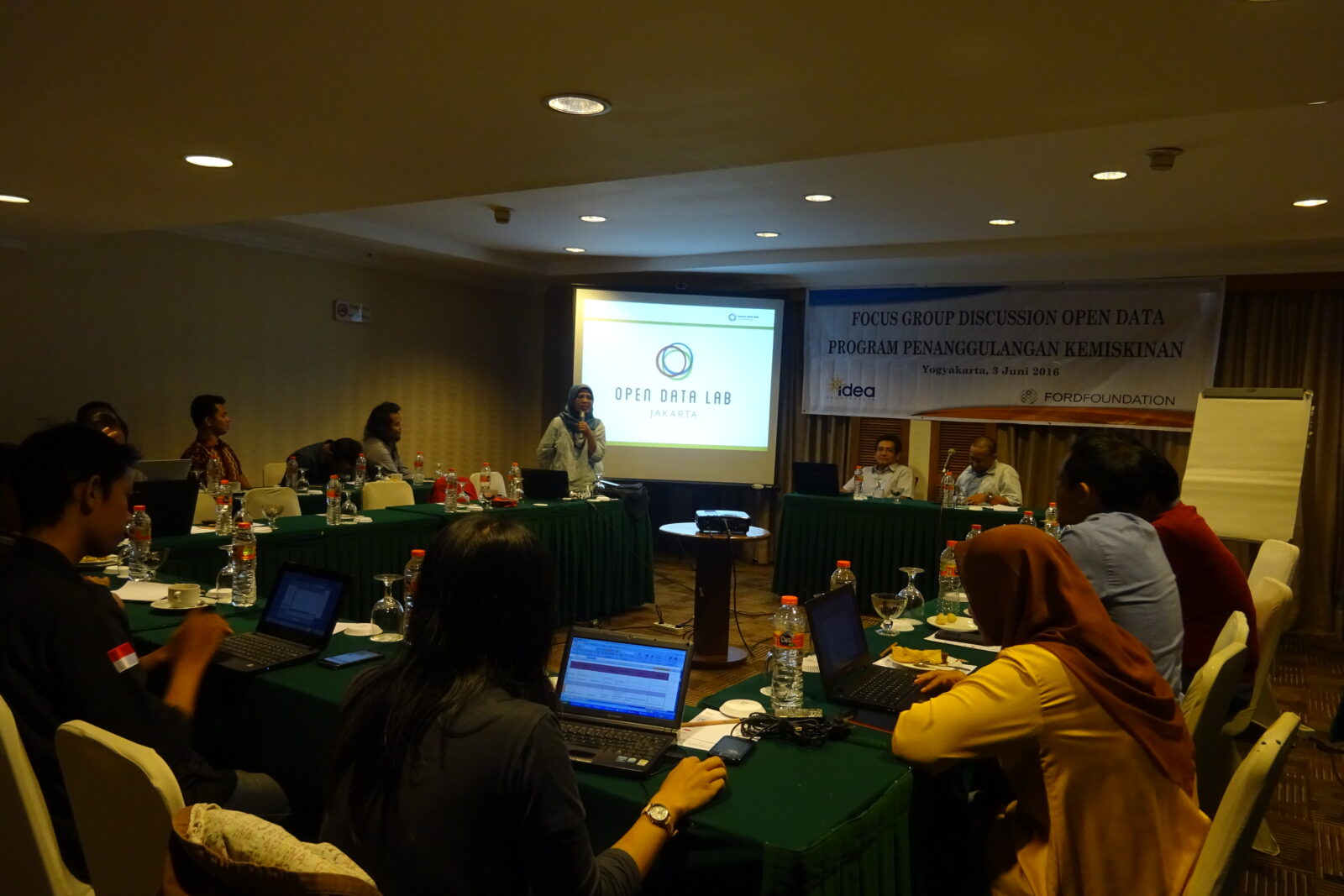
Some time ago, precisely on June 3, 2016, at the Grand Quality Hotel, IDEA tried to initiate the implementation of “open data” for the poverty alleviation program. This initiative took the title, “FGD Open Data for the Poverty Alleviation Program in Yogyakarta”. The entire process of initiating the implementation of “open data” is a collaboration between IDEA Yogyakarta and the Ford Foundation. This activity was also attended by the Regional Poverty Alleviation Team (TKPKD) in 4 (four) districts, 1 (one) city, and 1 (one) province.
The presence of this government element is one form of strategy built by IDEA to carry out the "engagement" process between each institution. Of course, the hope is that there will be no form of resistance from the government to the "open data" initiation process for poverty alleviation programs, and in the future the government will consciously replicate the "open data" initiation process that has been built together. And in a digital world like today, openness of information to the public is an inevitability that can no longer be rejected and avoided (again) by the government. After all, it must be truly believed that this openness of public information is a manifestation of public transparency and accountability. The public certainly knows that transparency and accountability are one of the pillars that formgood governance. [YPP, FAF]
 English
 Bahasa Indonesia