

As everyday life moves more and more towards the digital world, being offline means being excluded. That’s why it’s more important than ever for everyone of any gender, anywhere and regardless of income to have the ability to access and use the internet.
However, the fact is that half of the world is still offline, and the majority of them are women. Failure to close this digital divide, especially the gender gap in the digital aspect, results in the strengthening of offline inequalities, such as education, health, and employment. Consequently, it weakens global economic growth and development.
A number of challenges still prevent women from harnessing the potential of information technology, one of which is the high cost. This is because women on average have lower incomes than men. Another challenge is the cultural challenge of connecting with onlineaccess . Research shows that one of the main reasons women are not connected online is because of a lack of digital skills and knowledge.
Through this program, the IDEA Association encourages the digital divide to be overcome. Women, especially in villages, are also encouraged to access gender data related to their daily lives, are able to use gender data to achieve more gender-equitable development, know the allocation of village budgets for women's empowerment and more gender-responsive development.
This program has several important objectives, including strengthening women's knowledge and skills in accessing data from the village government's online portal. Then encouraging women to understand budget transparency and gender-inclusive development and to increase women's awareness of the importance of digital knowledge to obtain more equal and gender-sensitive development budget resources.
This program was run in 2019, precisely from May to December. The targets of this program are women's groups at the village level, including Women Farmers Groups, health cadres, women MSMEs, women informal workers, youth organizations and village SID managers. In addition, the program also targets government and community leaders, especially in villages. The location of the program is in the Special Region of Yogyakarta, namely in Bangunjiwo and Bawuran villages, Bantul Regency, and NTB Province, namely in Gelangsar village, West Lombok Regency.
The total number of beneficiaries in this program is 164, 64 men and 100 women. Organizationally, there are 57 people from the government, 102 community leaders and villagers, and 5 representatives from CSOs. Meanwhile, based on region, 51 beneficiaries of this program come from West Nusa Tenggara and 153 people from the Special Region of Yogyakarta.
In terms of funding, the Equals Digital Skills Fund program is supported by the World Wide Web Foundation and the German Federal Ministry for Economic Cooperation and Development. Meanwhile, in implementing the program, IDEA also collaborates with the Lombok Civil Society Network.
In addition to the Lombok Civil Society Network, IDEA's partners in implementing the program are the Governments in 3 target villages of the program, namely the Bangunjiwo and Bawuran Village Governments in Bantul Regency, Special Region of Yogyakarta, and the Gelangsar Village Government in West Lombok Regency, West Nusa Tenggara. In addition, IDEA also partners with women's organizations in the three villages, namely the Bunda Mandiri Home Workers Union from Bawuran Village, the Kasih Bunda Home Workers Union from Bangunjiwo Village, and the Tough Women's Caucus from Gelangsar Village.
Intervention Process
A number of series of activities are carried out to achieve the program objectives above. The process of implementing the activities begins with conducting Digital Literacy Training for women's groups, village leaders and village governments. In this activity, participants are introduced to the concept of gender, gender-related data, understanding of open data, and gender open data applications.
After the training, the village government and residents worked together to collect gender data. This activity is expected to encourage the availability of disaggregated gender data in the village and also provide specific data related to gender conditions in the village. Some of the gender data include data on domestic violence, the number of minority gender group participation in village public decision-making forums, child marriage, and data on female heads of households.
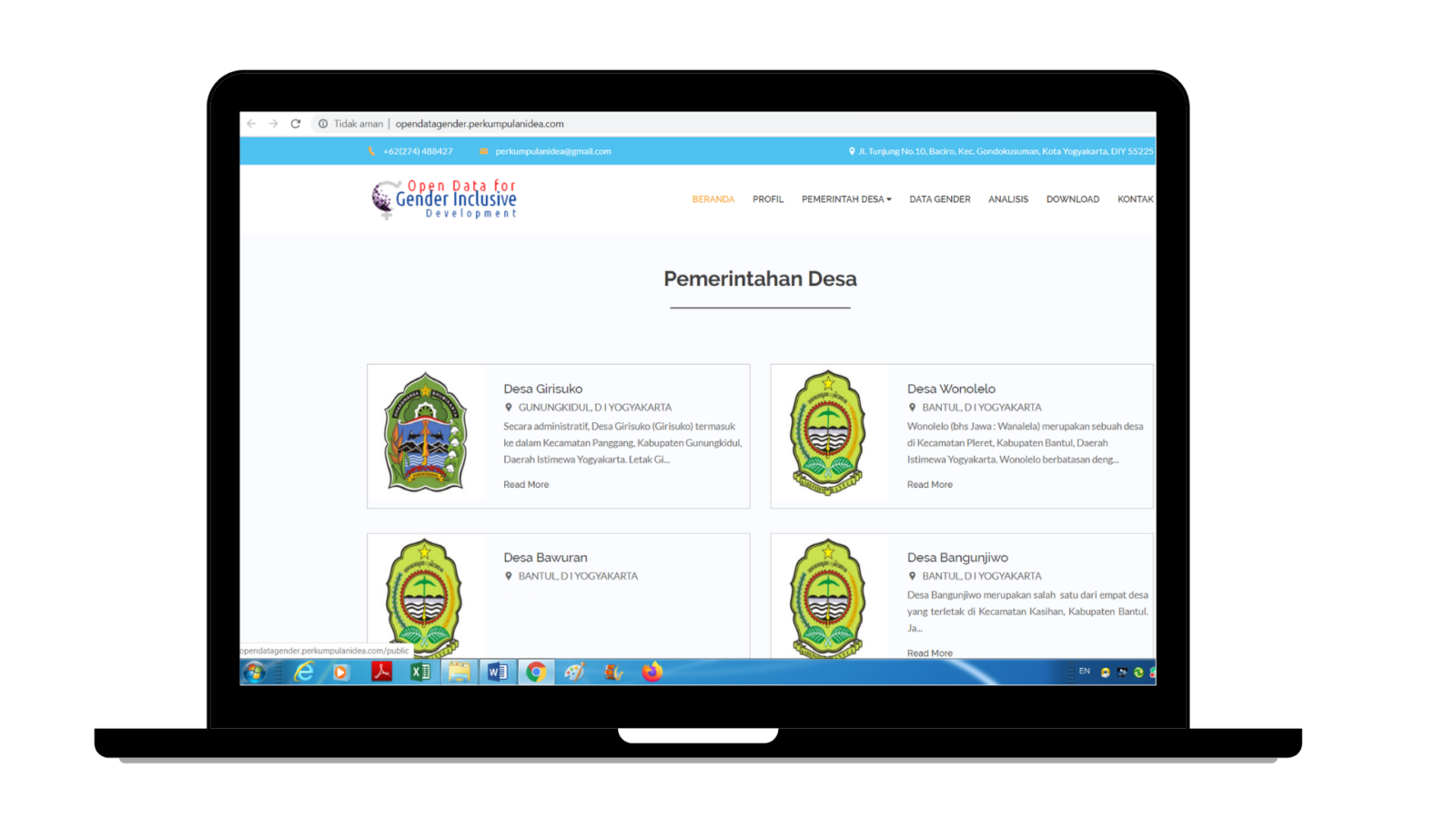
At the same time, IDEA is developing an application that contains gender data information and gender-responsive village budgets in each partner village. The results of the application development can be accessed via http://opendatagender.perkumpulanidea.com/.
To disseminate information on gender data and gender-responsive budgeting, the program publishes budget newspapers and banners. The publication aims to provide more villagers with information on village gender conditions, including the village budget that has been allocated by the village government to address gender issues.
The results of the gender data collection process, and gender-responsive budget information from the village government, which have been published on the gender open data website above, are then socialized to villagers in a special meeting. This activity involves the village government, community leaders, and more villagers (citizen engagement).
From the entire series of activities, this program was closed with a National Seminar. The goal is to disseminate good practices carried out by this program to the wider public, especially to citizens and governments in other regions and at higher levels of government.
During the implementation process, the implementing team created program documentation in the form of a documentary video. With this documentary video, it is hoped that the idea of digital literacy for women and data transparency will become wider. The documentary video can be accessed via https://youtu.be/aqLNVtYQh3o.
To get public feedback on this program, IDEA conducted a survey of the program's benefits. This survey was conducted on villagers and a number of community leaders in the beneficiary villages, both those involved in previous activities and those who were not. With this survey, at least IDEA can get an idea of the extent to which this program has an impact on partner villages.
Results Achieved
- From a number of activities carried out, there are a number of achievements that have been successfully achieved in this program. Some of the achievements that we have noted include:
- From the gender data collection process, villages receiving program benefits now have disaggregated gender data.
- In addition, the disaggregated gender data has also been published through the open gender data website. This website can also be used to publish information about gender-responsive programs/activities and budgets.
- The participation of women and other vulnerable groups, such as people with disabilities, is increasing in the planning and budgeting process. Village governments are now starting to involve women's groups, and other vulnerable groups such as people with disabilities, in decision-making discussions, especially in village planning and budgeting. Women's participation is also increasing with their involvement as partners of the village government to collect village gender data.
- The consequence of the participation of women's groups, and vulnerable groups in general, in the budget planning process, is that the allocation of the Village Budget, especially for vulnerable groups, becomes larger.
Contributor: Ignatius Klerek Mau
Editor: Ahmad Hedar
 English
 Bahasa Indonesia