

"Budget advocacy for poverty alleviation in the DIY Province has been part of IDEA's strategic program, at least in the last 10 years. This is considering the increasingly concerning conditions of poverty and inequality in the DIY Province."
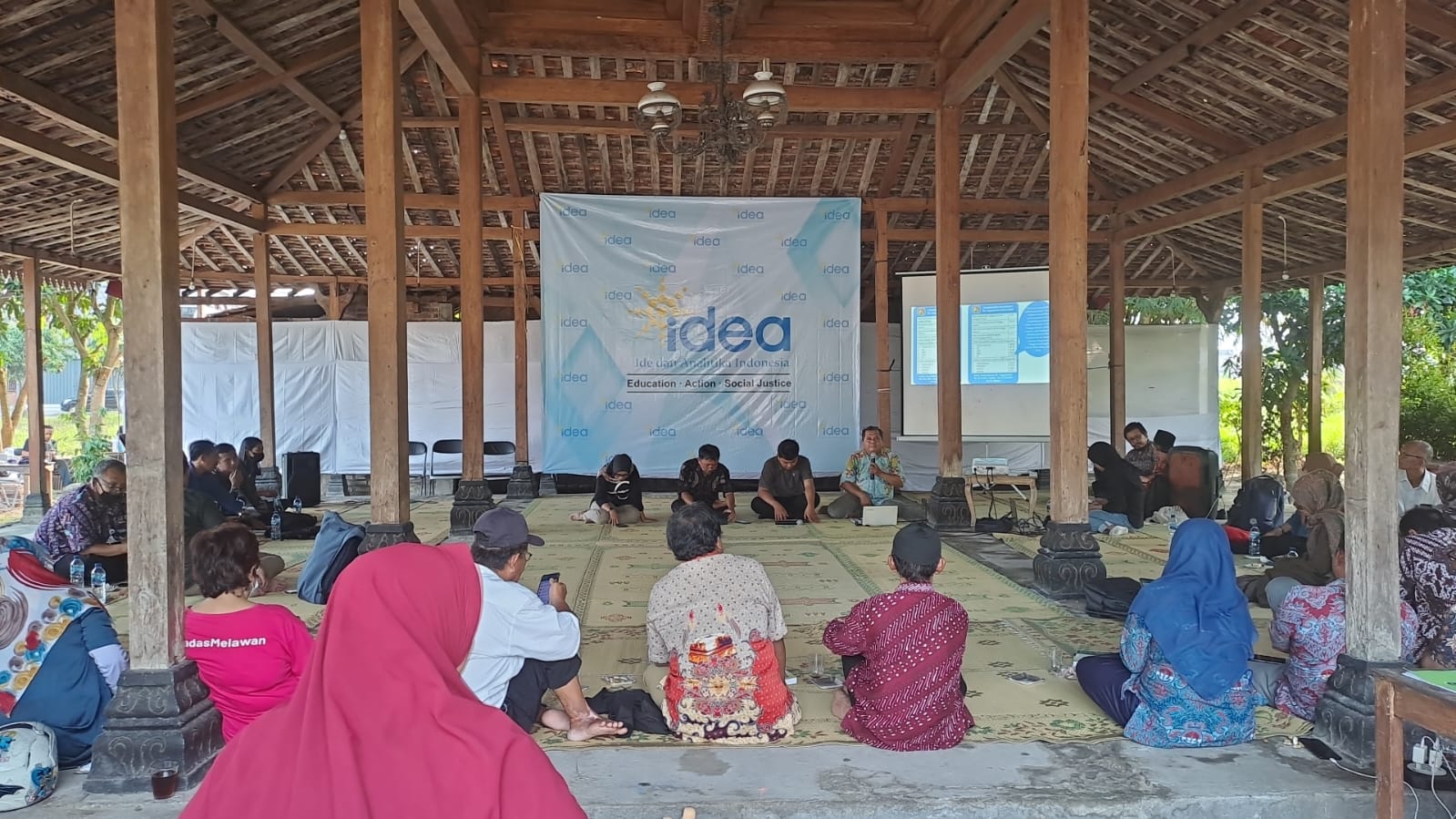
The topic was discussed in the 28th IDEA syawalan and seminar entitled "Utilization of Danais for Poverty Alleviation in DIY", which was sparked by the Head of the Sabermas Division of the DIY Bappeda, the Head of the Planning and Control Division of the DIY Special Region Panirandya, and the Director of IDEA Yogyakarta in Kampoeng Mataraman, Panggungharjo, Bantul, Friday (19/05).
In the workshop, IDEA presented a network of community organizations, provincial governments, district governments and village governments that have been partners. From community elements, vulnerable groups such as women and people with disabilities from all over the province of DIY, then there are the Provincial and District Bappeda in DIY, and several village governments such as the village heads of Panggungharjo Bantul and Sendangsari Kulon Progo, as well as from civil society organizations such as Yasanti, Rifka Annisa, LKIS, LSM Forum, and the DIY PRB forum.
As is known, in 2023, according to BPS data, the percentage of poor people in September 2022 was 11.49 percent, an increase of 0.15 percent compared to March 2022. This figure also makes DIY the province with the highest poverty rate on the island of Java and is included in the ranks of provinces whose poverty line is above the national average. In terms of distribution, the majority of poor people are in villages with a percentage of 14%. While the distribution in urban areas is 10.64%.
Apart from the issue of poverty, what is even more concerning is the DIY Gini ratio which is at 0.459, this figure is above the national Gini figure and is also the highest in Indonesia, in other words, the DIY Province is the province with the highest level of inequality nationally.
The utilization of funds for poverty alleviation is expected to contribute to the acceleration of poverty alleviation. Because, DIY program and budget interventions so far have not significantly reduced poverty rates, in other words, the decline in poverty rates in DIY has slowed down.
In 2022, the allocation of funds for poverty alleviation amounted to Rp. 29.5 billion, which was allocated for social assistance and community empowerment programs. However, in terms of percentage, this figure is very small, which is only 2% of the total allocation of funds which in 2022 reached 1.3 trillion. This is also a note so that in the future, the allocation for poverty alleviation continues to be increased.
Overall, the percentage of fund allocation in 2022 was allocated for Cultural Affairs at 55.43 percent, spatial planning at 39.99 percent, institutions at 2.68 percent and land at 1.90 percent.
Another note on the implementation of Danais governance is related to the low level of information transparency, Danais data is difficult to access easily by the public, so that its supervision is also weak. According to the results of the Regional Information Commission's monitoring and evaluation, the Special Region Panirandya as an institution that is given the mandate to manage policies, programs and budgets for special regions received a red mark, which means it is not informative.
In terms of participation, planning for fund allocation needs to consider the involvement of community groups to ensure that the planned programs and budgets are truly in accordance with community needs. Groups that need to be prioritized are especially the poor and vulnerable people such as people with disabilities, the elderly and women.
Finally, in terms of utilization distribution. The Danais program is expected to not only be allocated in urban areas, but also in rural areas, especially in poverty pockets in DIY such as Gunungkidul and Kulon Progo districts. This is done to reduce the disparity between rural and urban poverty.
 English
 Bahasa Indonesia