

Yogyakarta (IDEA) The Central Statistics Agency (BPS) noted in September 2013 that the percentage of poor urban and rural residents in the Special Region of Yogyakarta was 15.03%. Although down from the previous year's figure of 15.88%, the Special Region of Yogyakarta still ranks in the top 10 provinces with the highest poverty rates.
So why is poverty in DIY still in a high position? First, the absence of an adequate poverty profile causes a contradiction between the level of poverty and welfare. There is a comfortable condition that is culturally felt by the people of DIY so that there is a contradiction between the high level of poverty based on the BPS indicator on the one hand while on the other hand the DIY Human Development Index (HDI), the People's Welfare Index (IKRAR) and the happiness index occupy the top ranks.
Second, if viewed from the existing social class, DIY still has a heavy burden to solve the social welfare problems of its citizens. The population of DIY in 2012 was 3,514,762 (BPS, 2012). Of that number, the Ministry of Social Affairs stated that more than 37 thousand elderly people in DIY are still neglected, people with disabilities reach more than 33 thousand children, more than 1,400 are infected with the HIV & AIDS virus and more than 1,600 residents abuse drugs.
Third, the program intervention is based on national poverty data/profile, not based on local indicators. Based on verification by the district/city, it turns out that the data is different from the real conditions in the field. This data error is what gave rise to horizontal conflict in the community during the implementation of the PK program.
In the framework of implementing poverty alleviation programs, the availability of data on who and where the poor are is the basic capital in running the program. Accuracy of updated poverty data is a must. The data used by the regions so far refers to official data issued by the Central Statistics Agency (BPS). There are two types of data issued by BPS, namely macro and micro poverty data. Macro poverty data is usually used for geographical targeting while micro poverty is used more for household targeting purposes such as for social protection. The data that is often used as the basis for planning poverty alleviation programs is micro data that has targeted poor households.
Problems arise in the regions because the data used to determine the target of poverty alleviation programs in the regions often do not meet the reality in the community. This situation can be seen from the many complaints and input from the community that this poverty alleviation program does not target the poor. Seeing this situation, several regions at the district/city level have made many efforts to improve the quality of this data with various innovations. Districts/cities use local indicators and the development of information systems as poverty mapping tools. Data that is close to real conditions is obtained.
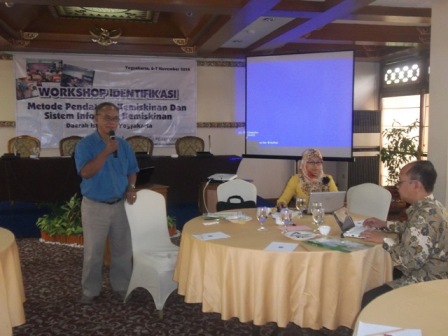
Considering that poverty is a multidimensional problem, poverty program management must be carried out in an integrated manner and not overlapping. Consolidated data and poverty information systems are expected to be able to answer the problems that have existed so far. Within this framework, the IDEA Association in collaboration with the Ford Foundation intends to follow up on the meeting related to poverty data collection in the form of a "Workshop on Identification of Poverty Data and Poverty Information Systems for the Special Region of Yogyakarta" held by the Coordinating Ministry for People's Welfare at the @home Gowongan hotel on September 5, 2014, attended by all TKPKD districts/cities and the Special Region of Yogyakarta. The process of consolidating the poverty data collection and information system will be followed up in this meeting. Through this process, it is hoped that the consolidation of policies, institutions, methodologies, and poverty information systems in the Special Region of Yogyakarta will be achieved.
 English
 Bahasa Indonesia