
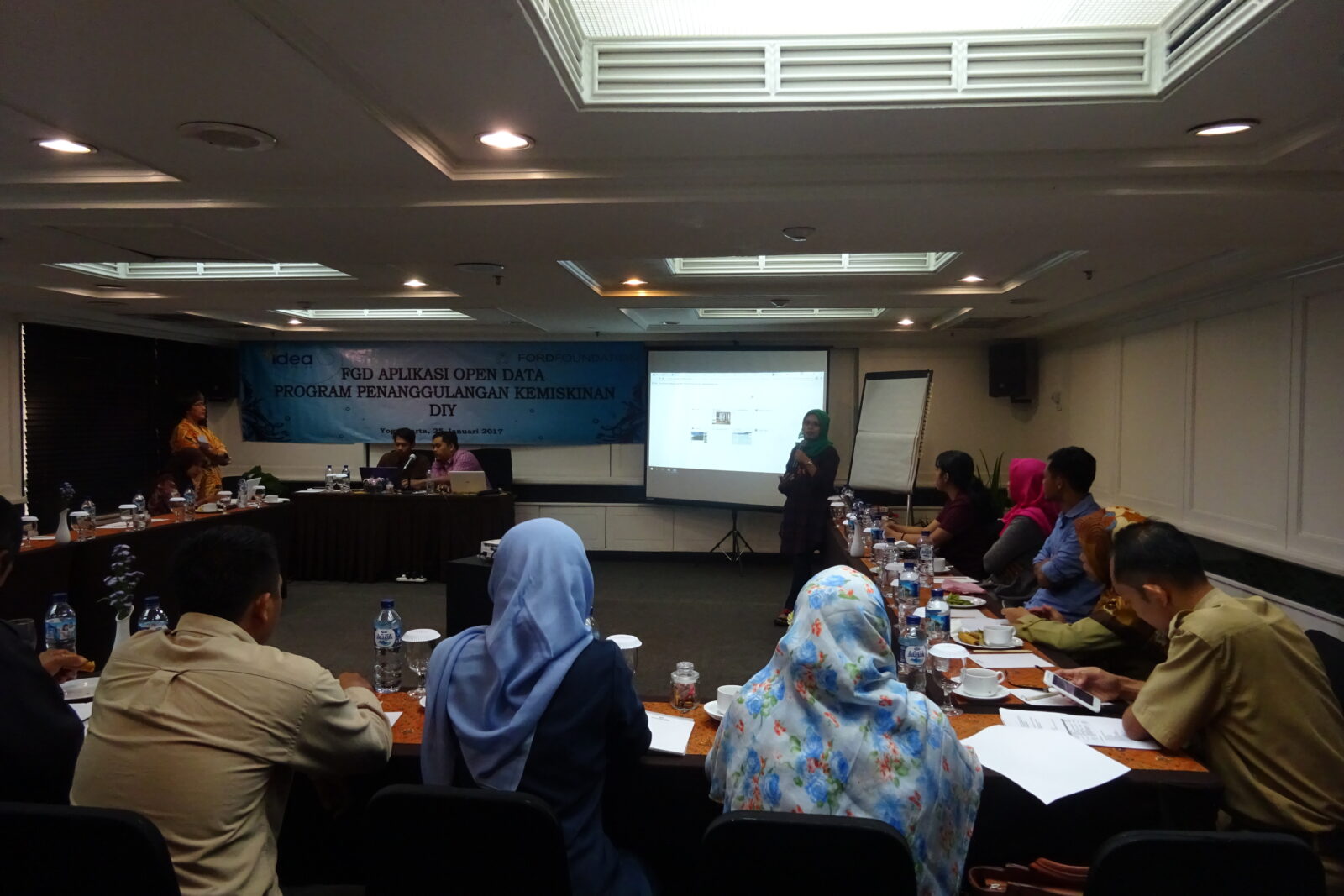

On January 25, 2017, IDEA Association – in collaboration with Ford Foundation conducted a Focus Group Discussion (FGD) II: Open Data Application “Arcapada”. This activity is a continuation of FGD I: Open Data Initiation, which was held in June last year. Several representatives from Regional Government Organizations (OPD) were seen attending this activity, including: IT Team of City/District Bappeda throughout DIY, TKPKD of City/District throughout DIY, TKPKD of DIY Province, and IT Team of Bappeda DIY. Almost all of the representatives from OPD who attended this activity were new faces. In addition to OPD, several participants from Girisuko and Dlingo Public Accountability Villages, as well as the SID Developer Forum, also attended this activity.
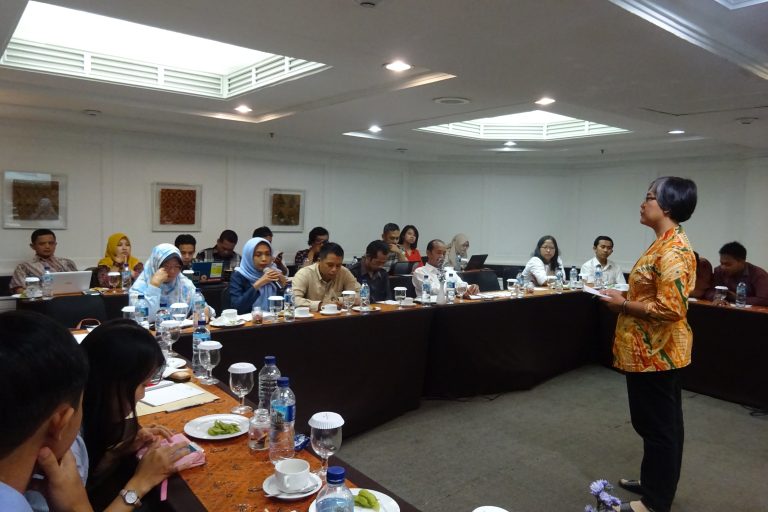
In this activity, the IDEA and Ford Foundation program teams explained the initiation process of developing open data in a systematic manner, starting from accessing regional budget planning documents (read: APBD), conducting the process of scraping cleaning APBD documents, developing open dataapplications, and entering the resulting data from scraping cleaning APBD documents into the open data. Aplikasi open data application. We deliberately named this open data application "Arcapada" (hereinafter referred to as Arcapada). The name Arcapada refers to 2 (two) twin stones on (mount) Semeru, which are the starting gate for climbing to the peak. We try to take that spirit, with the hope that this application will be the starting point for local governments to implement open data APBD documents through information systems. Instead of developing Arcapada with more interesting features.
Arcapada is the result of collaboration between the IDEA and Ford Foundation program teams and the information technology (IT) team. The program team mostly filled in the application content, while the IT team perfected the application from a technical perspective. Both complement each other. Arcapada itself was worked on by the program team and the IT team, for approximately 4 (four) months, starting from September - December 2016. Arcapada is able to document and read all APBD documents, starting from the village, district/city, and even provincial levels for the past 3 (three) years.
Arcapada's capability is quite capable intrack all budget items, both in the components of income, expenditure, and financing; including affairs, programs, activities, and sub-activities. No exception, the general aggregate of the regional budget. With such capability, we hope that the public will benefit from Arcapada, namely knowing the consistency and commitment of the regional government (which is manifested in the public budget) in efforts to fulfill the basic rights of the community, such as poverty alleviation, health, education, and so on.
Then, how does Arcapada work to track budget items? Arcapada works by using account codes and budget keywords as the main basis for system identification. With this identification model, Arcapada is able to compare budgets for programs, activities, and sub-activities; between each OPD within the scope of the local government. In fact, Arcapada is able to compare budgets for programs, activities, and sub-activities in the same OPD, but the local government institutions are different. For example, the budget for the Social Service in Bantul Regency, Gunungkidul Regency, and Kulonprogo Regency. The results of the Arcapada track display are quite interesting. First, budget data is presented in table format, including account codes, descriptions, nominals, and descriptions. Second, budget data is presented using bar and pie/circle charts, complete with account codes, nominals, descriptions, and descriptions.
In this activity, the IDEA and Ford Foundation program teams also simulated the operationalization of Arcapada to participants. The goal is to show that the Arcapada that has been developed is relatively easy to use by local governments and the community. In addition to using a personal computer (PC) Arcapada sangat mudah diakses melalui smartphone, Arcapada is very easy to access via a smartphone, The appearance of Arcapada on a PC and a smartphone is not much different. Arcapada is also equipped with an analysis feature to analyze the public budget. Also in this activity, the APBD document analyst team simulated how to analyze the budget using Arcapada.
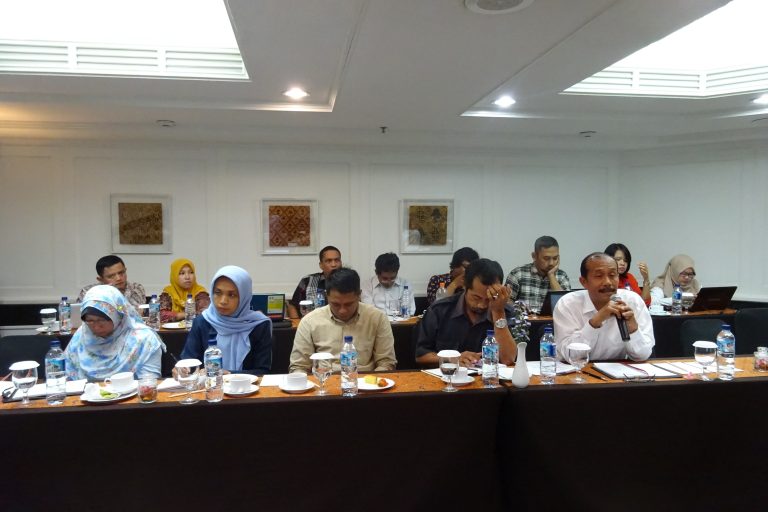
Several representatives from the Regional Poverty Alleviation Coordination Team (TKPKD) of the district/city and province; expressed their appreciation for the existence of Arcapada. Mr. Indra from TKPKD Kulonprogo Regency assessed that Arcapada will not only help the community, but will also help the local government. "So, we can compare our spending with other OPDs," explained Indra. The same appreciation for Arcapada was shown by Mr. Seno from TKPKD DIY Province, who assessed that the existence of this application will provide a (positive) contribution to the local government related to the budget.
Despite receiving various positive appreciations from representatives of local governments, Arcapada still has a few weaknesses, namely the limited ability to identify local government account codes. This limited identification is due to differences in budget account codes in each government. For example, the account code in local government A is different from local government B. Often, the account code in the local government changes from year to year. This fact is well understood by all representatives of local governments. This inconsistency in administration (read: account code) was also complained about by Mrs. Prantini, TKPKD of Yogyakarta City. "In the Yogyakarta City Government, we find it difficult because the account (account code) changes," said Prantini. Every year (the account code) changes, so if it has not been revised, it cannot be implemented at the budget change stage for activities," she said. With conditions like this, it certainly makes it difficult to develop Arcapada in the future.
The problem of budget account codes is quite crucial. Alignment of budget account codes in all districts/cities and provinces throughout DIY is a "homework" for stakeholders in encouraging the implementation of one open data application in DIY. Moreover, technically, Arcapada did not encounter significant obstacles.
Currently, we are entering a crucial phase in promoting a DIY open data application. Regardless of the issue of inconsistency of budget account codes in each regional government, the implementation to integrate Arcapada into the government's tapakmaya portal is important to do now. All regional governments appreciate and agree to the integration of Arcapada into their tapakmaya portals. But that is just lip service that must be demanded for commitment (continuously). And this phase is the most important phase in the initiation of open data applications in DIY. The future of the DIY open data application is at stake. The chances are equally strong. It could be that this application will be implemented in all district/city and provincial tapakmaya portals, but it could not; like a penalty kick with two possibilities, goal and no. Consistency of attitude and commitment of stakeholders is the key to the success of the implementation of the open data. Once again, the chances are still fifty – fifty .[Yoga Putra P]
 English
 Bahasa Indonesia