
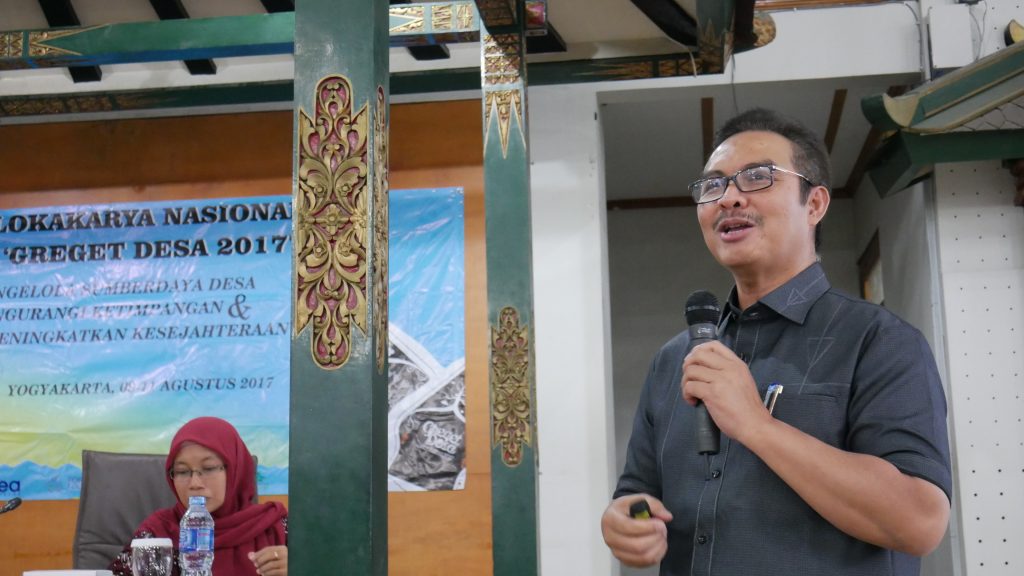

Kulonprogo Regent for the 2017-2022 Period Hasto Wardoyo said that to overcome the problem of poverty, his region was able to overcome it by optimizing local potential. During his leadership, various potentials such as water sources, rice, andesite stone, home batik and brown sugar were successfully managed in such a way that they became superior products.
This optimization is realized through the Bela Beli Kulonprogo program. Bela Beli Kulonprogo is a movement that aims to increase independence and welfare by faithfully buying various local products produced by the Kulonprogo community. This movement has been quite successful in reducing poverty, because the majority of production is carried out by the poor. In addition to poverty alleviation efforts, this step is also intended as a strategy to deal with international trade that cannot be avoided according to him.
"Bela Beli Kulonprogo, be loyal until death, die consuming food, ngombe (drinking), and homemade clothes. International trade integration is inevitable, responded to with a strong ideology by buying local products," he said.
The presentation was delivered by Hasto in a discussion entitled "Poverty Data Management to Reduce Inequality and Increase Welfare" on Wednesday, August 9, 2017, at the Radyosuyoso Building, DIY Provincial Government Office Complex. This discussion is part of a series of National Greget Desa 2017 workshop discussions that took place on August 9-11, 2017.
In addition to Hasto, this discussion also brought in a facilitator from the National Team for the Acceleration of Poverty Reduction (TNP2K) to focus on exploring issues related to poverty data management. Mahfud DH as a representative of TNP2K conveyed one important point related to the problem of poverty data management, namely the phenomenon of Inclusion Error and Exclusion Error. Inclusion Error is a condition where people who are not eligible for poverty alleviation programs are recorded as recipients in the government database. Conversely, Exclusion Error is when people who are actually eligible for the program are not recorded in the database.
“Inclusion error, people who are not eligible to receive the program actually receive the program. While Exclusion , people who should be able to but do not get the benefits of the program," he said.
As a result of the chaotic data governance in Indonesia, we need to pay special attention to this phenomenon. According to him, mitigation steps can be taken through the government's Independent Update Mechanism (MPM) service. This service allows people who are included in the Exclusion Error to register themselves in the database independently.
Participants who came from various levels of central and regional government, including villages, NGOs and various media appeared enthusiastic in following the discussion.
In the Q&A session, for example, Nursamsu, a representative from the Directorate General of the Poor, Ministry of Social Affairs, expressed his opinion that problems related to data governance are not easy. Updating data, for example, requires cross-sector involvement to validate, so the process carried out is quite complicated. He gave an example in Makassar, where errors related to data were caused by the population not being updated.
"This data is not as simple as we think. There are various cross-sectors involved in the validation process. In Makassar, the error was due to the population numbers not being updated."
In addition, there is also an interesting question from Rani Yakum about how to include disaster data in the priority development plan to eradicate poverty. This is because disasters such as crop failures, landslides and other disasters are major contributors to poverty conditions.
"In the last five years, small-scale disasters have been a major contributor to poverty. For example, crop failures, landslides. Disaster-prone areas are on the poverty line, how to include disaster data in development priorities to eradicate poverty."
The discussion then ended with the signing of a Communiqué by discussion participants as proof of their commitment to making data governance a success in order to overcome poverty.
 English
 Bahasa Indonesia