
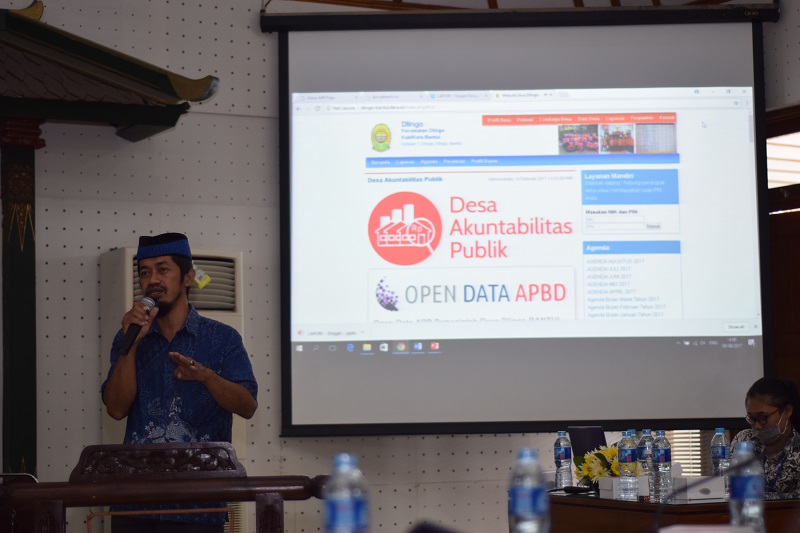

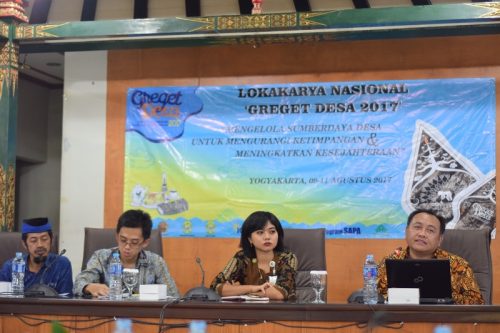
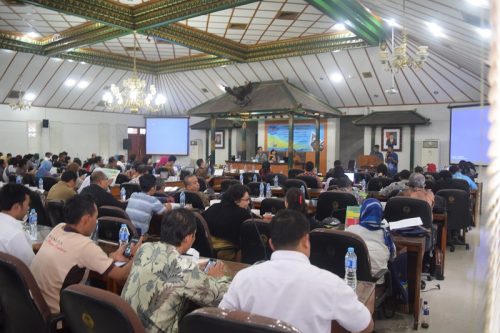
The series of discussions of the 2017 Greget Desa national workshop continued on Wednesday (09/17). After previously holding a discussion session I with the theme "Poverty Data Governance”, This time, at exactly 13.30, discussion session II was held with the theme “Managing Resources in a Participatory, Transparent and Accountable Mannerel”. Taking place in the Radyo Suyoso room, the governor's office complex of the Special Region of Yogyakarta, this discussion was attended by 200 participants, representatives from several village officials, NGOs, local governments and ministries.
The discussion was attended by four speakers, including the head of Dlingo village, Bahrun Wardoyo, the Ministry of Villages and Development of Disadvantaged Regions, Bito Wikantosa, Open Data LAB Jakarta, Aditya, and the office of the presidential staff Deputy I, Monita. Although discussing the same topic, the four speakers delivered with different study focuses.
Fachrul Sahmega, who moderated the discussion, gave Bahrun Wardoyo the first opportunity to deliver the material. There were several main points conveyed by the head of Dlingo village regarding accountable village management. Bahrun said that the Village Law has provided strong legality for the existence of villages in Indonesia. Therefore, before realizing village accountability, according to Bahrun, there are several things that village managers must be aware of, especially regarding village potential.
"A village head has territorial power and authority, a population that must submit to and obey village regulations, as well as the potential assets and budget owned by the village," said Bahrun.
This awareness seems to be applied by Bahhrun in Dlingo village. As is known, Dlingo Village is a village that has received many awards in recent years, especially related to accountable village governance. Located in Dlingo sub-district, Bantul Regency, the village has the nickname Dlingo Giriloji. According to Bachrun, the jargon is based on the governance concept that he applied in Dlingo village.
“Dlingo Village, with the concept of Dlingo Giriloji. Giri gunung, loji, nice house. We are building a smart culture village. The stages have been partnered with NGO friends on how we should build accountability. A combination of culture and technology. Measurable, can be realized and has a time frame. Smart is alon-alon waton kelakon ("slowly but surely it will be achieved"). In order for this to be kelakon (achieved) only 1 is there dilakoni(done), there is a vision. Achieved if there is something to be achieved. Waton is a rule. When you want to do something, there must be rules and stages. Alon-alon is careful and full of calculations," said Bahrun.
Bachrun added that he also built a new paradigm for the village apparatus (pamong). He did this to create ethos and emotion in managing the village. "We build by changing the paradigm for pamong. We try to build what we used to call Dlingo people. With that concept of managing a village, only one thing is needed, which is pride. We as villagers, must have something to be proud of in our village," he said.
Managing a village, Bachrun explained, must not give up with limitations. Instead, these limitations must be a motivation to continue to improve the quality of village management. For him, even a limited village still has potential if explored.
"We must not give up with our limitations, low human resources, far from the city, that is our spirit. Higher resilience. When we do something out of the ordinary it becomes extraordinary. Whatever the condition of our village, we must continue to explore its potential, there must be something we make for our pride. The brains in the village head must have an "I love the problem". Maindset mindset. Our brains are solution-oriented, proving that the state is present in the village," he stressed.
Budget Planning to Improve Village Community Welfare
Next, Bito Wikantosa, who represented the Ministry of Villages and Development of Disadvantaged Regions, delivered several main points related to Budget Planning to Improve Village Residents' Welfare. According to Bito, the realization of the village budget, which is mostly allocated for infrastructure development, does not always have an impact on residents' welfare.
"The type of village facilities does not always have an impact on reducing poverty. The choices that have a greater impact on improving village welfare are lower. The planning and budgeting system for villagers. Who will determine that the budgeting will improve people's welfare," said Bito.
In building a village, Bito continued, it is necessary to pay attention to the principal aspects such as democratic governance and social justice. According to him, the village has rights because of its origin. It has customary law, customary objects. These rights are what manage the village. The village has the ability to build the mandate of the Village Law. No less important, according to Bito, is the need for openness of information and data in village development planning. Technocratically it must be formulated, because the work of the government and the work of technocracy is integration, one village one planning.
Bito also reminded about the importance of integrated village development based on assets. This is done to empower all forms of village assets that have the potential to improve the welfare of the community. "The orientation is budget spending, potential village assets that can be used for village empowerment. Planning in the village does not just stop in the village, using development areas, there is integration with the city district," he said.
Meanwhile, regarding the National Medium-Term Development Plan (RPJMN) in the Village, Bito emphasized that it should be studied objectively. Not without reason, because development carried out in the Village, continued Bito, must have a clear and measurable direction and orientation.
"Now it must be very objective, because it concerns the budget that is managed independently. Assessment of the village situation, data system, community proposals must be explored, and asset mapping. Where will the village be taken, if village planning has no direction," said Bito.
Open Data as an Instrument of Public Accountability
To realize village management accountability, a comprehensive understanding of data governance is needed. That point is at least what is of concern to Aditya, the third speaker from open data, LAB Jakarta. Aditya provided a basic understanding of the principles of open data. According to him, this is important to know as a provision for understanding when managing data.
"The principle of open data at least meets the criteria such as standard provisions that have been published, are timely and comprehensive, can be easily accessed, are easily compared and interconnected, the goals to be achieved are improving government, and more inclusive Innovation and Development," said Aditya.
Regarding its usefulness, Aditya explained that the benefits of open data are numerous, including increasing government transparency and accountability, creating new economic opportunities, increasing efficiency and public services, increasing the effectiveness of government development planning, and increasing public participation in the decision-making process.
Report as Citizen Watch Media
Meanwhile, for the last material, this discussion specifically explains the function of 'Lapor' as a media that can be used by citizens to monitor the performance of public services. This explanation was guided directly by Monita as Deputy I of the presidential staff office.
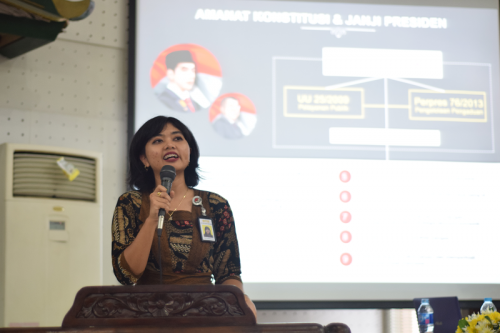
"Have you ever heard about lapor? Lapor is a public complaint system. Both related to public services such as damaged roads, BPJS, even to civil servant affairs. There are derivatives of nawacita numbers 1 and 2. Here, lapor acts as the eyes and hands of Mr. Jokowi," said Monita.
Monita said that few complaints do not mean that public services are good, this could be due to the lack of public knowledge about the media and its reporting system.
“There is a myth, few complaints, public service is good? I disagree. Are complaints resolved or not. Managing complaints, adding to the workload? No. Complaint management only becomes APIP? No. Complaints can become an arena for slander and pointless debate? No. If there are no reports, we must find the source of the fire,” Monita emphasized. [AH]
 English
 Bahasa Indonesia