
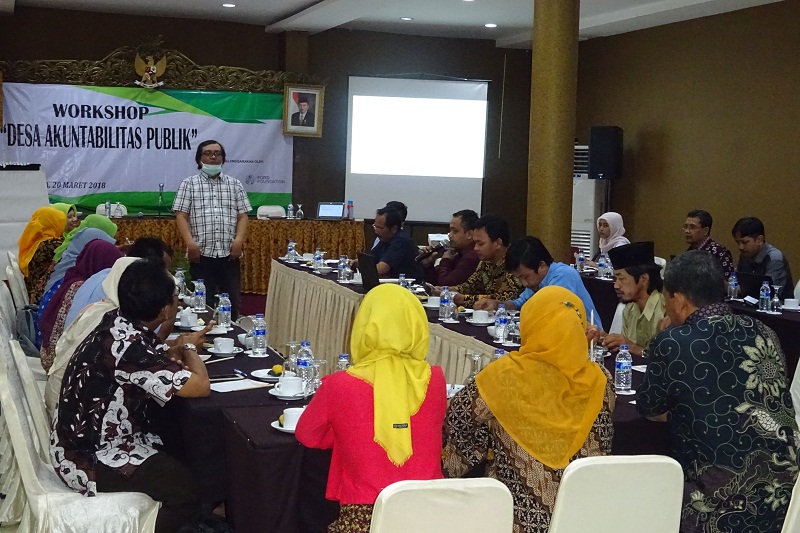

Yogyakarta, IDEA – In order to get an overview of the management mechanism of Public Accountability Village (DAP), including improving the Application, Institutional Management, Budget, and Technical Guidelines for Village Management, IDEA Yogyakarta together with the Ford Foundation held a DAP workshop at the Rose Inn Hotel, Yogyakarta, Tuesday (20/03). This workshop was also held to obtain reflective notes, shared understanding, and identification of implementation needs related to the DAP concept.
IDEA Director, Sunarja, while giving a speech at the workshop said that before implementing DAP, the village must first have a standard for public information transparency. According to him, if the village already has the standard, then all that remains is to utilize all systems or mechanisms to open all information in the village.
"The form can be adjusted to the conditions in each village, by using media, Village Information Systems, banners and pamphlets," said Sunarja.
According to Sunarja, the more village fund allocations there are, the higher the level of vulnerability. If not careful, he said, it will be an obstacle to achieving an accountable village. He gave an example of the many corruption cases that ensnared the village government due to the low understanding of the importance of transparency and accountability.
"To run according to the corridor, the policies made, must be opened information related to development planning to its budget. When there are things that are not appropriate, the public can provide input and corrections, so that performance is better and the program is right on target," he said.
As is known, in IDEA Yogyakarta's records, over the past three years, the implementation of the Village Law has not been fully optimal. Fiscal decentralization in the form of Village Funds (DD) and Village Fund Allocations (ADD), has not been widely felt by the community. Instead of providing welfare for villages and their communities, DD and ADD have become a "meal" for corruption. Village independence and welfare as the goal of the Village Law, should be monitored together by stakeholders, such as the central government, village governments, village activists, and the community through transparency and public accountability. Transparency and public accountability themselves are one of the pillars ofgood governance, and should be an important pillar at every level of government in Indonesia.
Also read: People with Disabilities Have the Right to be Involved in Village Planning and Development
Hernindya Wisnu Adjie, who became the workshop facilitator, said that in this activity, IDEA brought together two of the best villages that are SID developers. Namely Dlingo Village, Bantul, and Sawaha Gunungkidul. Dlingo Village itself has a website that has been visited by more than 3 million people. Meanwhile, Sawahan Village is the only village whose village website already has a variety of thematic maps (T-Maps).
As an idea/concept, DAP has three main prerequisites, namely transparency of government administrators in determining public policies by accepting input and involving various institutions, then the existence of performance standards in each institution that can be measured in carrying out its duties, functions, and authorities, and participation to mutually create a conducive atmosphere in creating public services with easy procedures, low costs, and fast services.
Riski from Sawahan village who also attended the workshop conveyed several things related to DAP. According to him, the implementation of the Sawahan village government is related to the village of public accountability, realizing that activities and programs will run well if supported by community participation. Riski considers community participation to be the main point of success of the government's main program.
"In order for the community to participate, of course it requires accurate public information, so the village government is required to provide information to the community. It can be delivered as optimally as possible through conventional media, banners, to digital media such as SID, Youtube, and Medsos. Because we are very aware that information will raise participation," said Riski.
Furthermore, Riski also revealed that the community needs accurate data, so that in Sawahan Village, the delivery of information related to village activities/programs is carried out as optimally as possible.
"One of them is with thematic maps, we optimize location-based data, so that during development planning it is more focused and the program can run according to community expectations," he said.
Affirming Riski's words, the village head of Sawahan, Suprapto said that in realizing transparency, he and all of Sawahan's village officials were mentally prepared to respond to criticism. As the village head, according to Suprapto, he upholds the principle of togetherness.
"So whatever is planned, we discuss it with all parties involved. The proposals submitted are cross-checked in the field and decided by consensus," he said.
Also read: DIY's Big PR in the 2019 RKPD Musrenbang
Meanwhile, the head of Dlingo village, Bahrun Wardoyo conveyed the practice of DAP in his village. According to him, Dlingo village has so far maximized the use of SID in conveying information related to village activities and programs. He admitted that Dlingo village is indeed focused on news (village info).
"Currently in Bantul district, the process of synchronizing SID and SIAK is underway. SID services can be received at sub-districts and regencies. SID in Bantul is mandatory at the village level," said Bahrun.
According to Bahrun, although small, Dlingo village has allocated budget for SID. However, its implementation is still optimized, because for him, SID can contribute to advancing the village.
"At the end of this period, we hope that when there is a change of leadership it will not affect village policies. We always provide an understanding regarding public accountability villages. In fact, in 2018 we synchronized with SIAK," said Bahrun.
Sukanda, Bahrun's colleague, who is also a Dlingo village official, expressed his opinion on the importance of setting priorities in implementing DAP. According to him, this is important to implement because the needs of each village are different.
"The budget from the district if applied to the village level must be made a priority scale. Dlingo Village for the DIY level is included in the poor villages, so we must make a plan for the priority scale. If in Sawahan Village there is house renovation, in Dlingo there is already assistance for livable houses from the central and provincial governments. So in our APBDes it is not prioritized for house renovation," said Sukanda.
After presenting reflectively regarding the understanding of DAP, the two villages then held a Group discussion to identify the needs for implementing the DAP concept. Guided by Adji, as a facilitator, the identification process began with an inventory of the phases/stages followed by formulating capacity building to support the stages created.
For Dlingo village, there are two stages made in identifying the needs of DAP implementation, the first is Open data including APBDes Application, Infographics and Siskudes, the second is the creation of E-Budgeting. These stages are followed by capacity development such as basic training of Open data and Data Application, as well as the formation of a team for E-Budgeting.
Meanwhile, in Sawahan village, E-Budgeting, which is also formulated in stages, is followed by capacity development starting from the preparation and management of the application, socialization to residents, planning, implementation to reporting.
Contributor/Editor: AH
 English
 Bahasa Indonesia