
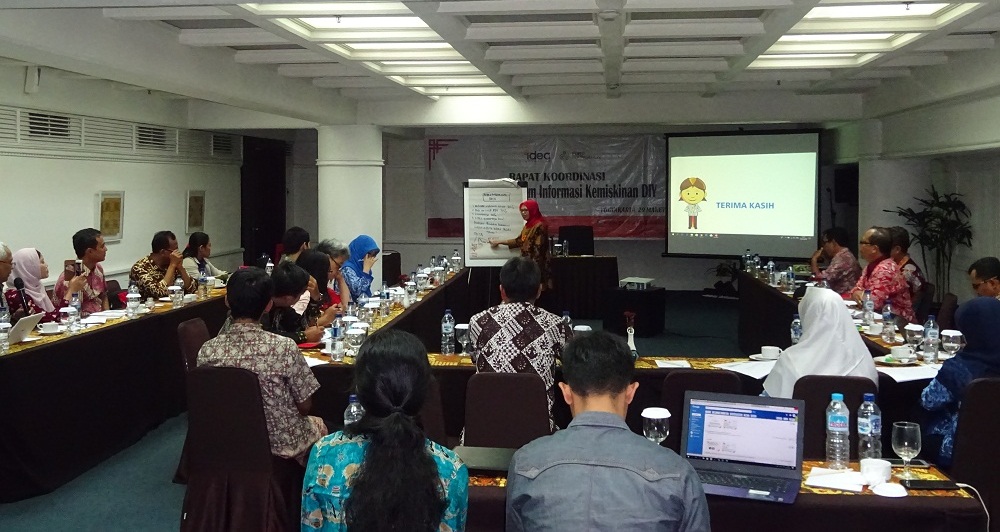

Yogyakarta, IDEA- In order to coordinate with multi-parties related to the integration of poverty data and information systems, as well as to determine strategic steps to accelerate the integration of poverty information systems in the Special Region of Yogyakarta, IDEA Yogyakarta supported by the Ford Foundation held a coordination meeting on the Integration of the Poverty Information System in the Special Region of Yogyakarta, Thursday (29/03). The coordination meeting held at the Santika Hotel involved the DIY Bappeda, all Social Services at the district/city and DIY Province levels, as well as the Bappeda IT team and the TKPKD Data Working Group Coordinator in all districts/cities in the Special Region of Yogyakarta Province.
As is known, poverty is still a crucial issue for the government, both central and regional. In the scope of DIY, currently the poverty line has reached 13.10% and is ranked 13th poorest province in Indonesia. This condition encourages the DIY government to carry out various approach strategies based on the root of poverty problems. One important aspect to support poverty alleviation strategies is the availability of accurate and targeted poverty data.
Based on the Regulation of the Minister of Home Affairs Number 42 of 2010 concerning the Coordination Team for Poverty Alleviation in Provinces and Districts/Cities, Article 1 states that the Poverty Alleviation Program is an activity carried out by the government, regional governments, the business world, and the community to improve the welfare of the poor through social assistance, empowerment. Within this framework, the IDEA Association together with regional governments at both the DIY and district/city levels collaborate to carry out several series of activities to realize better quality poverty data so that it can be used to encourage poverty alleviation programs.
Also read: Encouraging Village Transparency and Accountability, IDEA Initiates DAP
One of the achievements in the cooperation is the commitment of the DIY government and the districts/cities to realize one poverty data in DIY. The commitment was followed up with an agreement on the use of the 2015 BDT database and the integration of poverty information systems between DIY and the districts/cities.
According to Sunarja, IDEA will facilitate coordination between the DIY government and the district/city regarding one poverty data. Moreover, said the IDEA director, Bappeda has planned to synchronize one poverty data between the city government and the district/city.
"Data from bottom to top is connected. The existence of the Poverty Information System-Next Generation, even though the district/city already has SID," he said.
Furthermore, as a discussion material, Sunarja gave a question to the forum attended by policy makers related to the implementation of this SIK. "Now the question is, how do we build a mechanism related to the one data system, so that data synchronization is easy?, What is the commitment of DIY and the district/city? and how far has the progress been developed so far?," asked Sunarja.
Isnawati, IDEA's One Data Project Manager said that this Coordination Meeting was the first in 2018. According to her, in realizing one data in DIY, in 2014 it began with a data identification workshop. Isna shared IDEA's experience in encouraging community advocacy, that data issues are often a crucial problem in poverty alleviation.
"Invalid data has an impact on the programs being run even though the budget has been disbursed a lot. The data issue is discussed at various levels. We agree to create a poverty database that is a reference for OPD," he said.
Isna hopes that this Coordination Meeting can produce agreements related to data content and the system/application that runs it. Therefore, after this activity, according to Isna, another meeting is still needed to produce a guide for integrating poverty data until its use.
"Data content means that there is one poverty alleviation program data to improve the database, namely the BDT issued by TNP2K. Then if the system/application, each district/city already has a data system, and is synchronized," he said.
Abu Yazid from the DIY Planning and Development Agency (Bappeda) said that the poverty index has increased in the city of Yogya, and decreased in other districts/cities. According to him, Inclusion errors and exclusion errors are what make poverty rates not decrease.
"The most significant problem in poverty alleviation is the still high number of Inclusion Error and Exclusion Error. Ensure that there are no errors in the Target Households Recipients of the Program, this is what we must resolve from data verification," he said.
Furthermore, Abu offered a double track strategy, namely the first is to improve the mechanism and data collection system, then carry out targeted interventions, for people in deciles 1 and 2, guarantee programs are carried out, while for people in deciles 2 and 3, empowerment and productive economic programs are carried out.
As the data presented by Abu, poverty in Sleman Regency and Yogyakarta City has begun to touch hardcore poverty. This means that more cannot be eradicated. Therefore, according to him, for the 3 regencies that have not touched hardcore poverty , it can be done with a poverty alleviation program that prioritizes a social capital approach that provides direct economic effects.
"A real example is the management of local community-based tourist attractions," he said.
Also read: Three Vulnerable Groups in Yogyakarta City Formulate Accessible Budget Documents
Regarding data updates, DIY itself, according to Abu, entered the 2015 PBDT. However, the data, both the process and the results, were submitted to TNP2KP at the Ministry of Social Affairs, and the BDT was determined by the Ministry of Social Affairs. The data, said Abu, was not only from TNP2K, but was also added from the Ministry of Social Affairs, so when combined it was not the same.
"Verification has been done and submitted to the Ministry of Social Affairs, but it has not been completed. We will use TNP2K data from 2015. Meanwhile, the Ministry of Social Affairs data from in and ex errors. The best data from BDT 2015, and verified from district/city data. Data from districts/cities will be used for the database. The center can only use central data," he said.
Meanwhile, for the integration of the poverty information system, Abu hopes that the Poverty Alleviation Management Information System (Simnangkis) in DIY and SIK-NG can be integrated.
"We will try to integrate this. The results of the district verification go to the province. The opportunity to integrate this system, let the forum align its perceptions," he hoped.
Poverty Data Management and Information Systems at the Ministry of Social Affairs
Gondang Arief, representing the DIY Social Service, conveyed many things related to the process of managing data and poverty information systems at the Ministry of Social Affairs. He explained the beginning of the implementation of SIK by the Ministry of Social Affairs.
"SIK-NG has been around for a long time, before 2015. There was SIK generation I in 2017, entered the 2015 BDT data with the stipulation of the Ministry of Social Affairs Decree No. 57. Not only BDT data, but also Ministry of Social Affairs data, especially PBI data," he said.
In 2017 there was a refinement of the 2nd social welfare information system. Based on BDT data from the Ministry of Social Affairs 163. BDT data and Rasta program data. In sik-ng, the basis can be online and offline as well as android.
Gondang revealed that SIK-NG has three versions. The system is used for districts/cities with online and offline versions, "we have only used the offline version to update data. Whether it reaches the village depends on the sub-district. Whether it will be done by the village to update data or submitted to the district," he said.
Furthermore, Gondang said, the latest generation of SIK-NG only has BDT data and Rastra data. According to him, there are still many considerations to include PBI/JKN data. Because, if PBI is entered, BDT data will automatically increase. In fact, the hope is that all program recipients are based on BDT data.
"What is in SIK-NG for the time being is only the Rastra or BDT program. Uploading the data results is done by the district supervisor. The new Rastra data proposal requested must have data from the village and village muskel. Updating is not the authority of the district/city, but the ministry/center," he said.
Meanwhile, for data improvement, Gondang said it is done every month. From the district/city proposal, his party hopes that the data improvement will be at least on the 15th of this month to be proposed to the Ministry of Social Affairs. So that the following month can be determined as the data for Rastra Beneficiary Families.
"For BDT data, it is carried out every month, and its determination is in a year. To be precise, twice a year, in May and November. If the district/city has not made a proposal every month, the data will automatically be the same as before," he said.
After the presentation and discussion were completed, this coordination meeting produced a follow-up plan as a commitment to implementing SIK integration. The RTL that will be implemented in the future is related to the Validation of poverty data from verification results, Data submission to the province, Overlay of SIK-NG SID data, Data Collection, and Meetings to fill in the substance of the DIY poverty alleviation regulation.
Contributors/Editors: AH
 English
 Bahasa Indonesia