
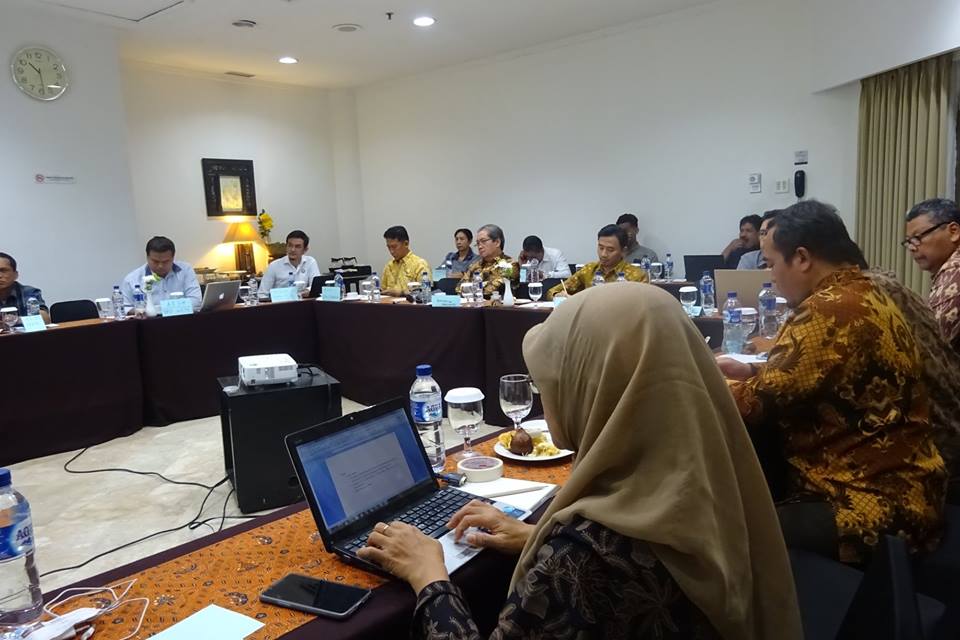

Yogyakarta, IDEA – In order to design updates and improvements to political party financial regulations, IDEA Yogyakarta in collaboration with Indonesia Corruption Watch (ICW) conducted a Focus Group Discussion (FGD) related to 'Political Party Funding in Indonesia and Reform Recommendations', at the Santika Hotel, Yogyakarta, Wednesday (08/08). A number of political parties such as PDI-P, Berkarya Party, PKS attended the FGD. Also present were representatives from the KPU, Bawaslu, Kesbangpol, and a number of civil society organizations such as IRE and PUKAT UGM.
This FGD was conducted to discuss and deliberate on several strategic issues related to political party funding in Indonesia. Some of them include recalculating the amount of state subsidies to parties and their allocation, redesigning reports and audit mechanisms, regulating transparency and openness aspects, building external supervision and law enforcement, and appropriate sanctions given to parties for any violations of the above matters.
As reported in the conclusion of the ICW study since 2011, the major problem that caused the shift in the orientation of the party's struggle was related to the party's financial system. The party was not only not transparent and not accountable to the public, but was also trapped in a circle of party financial problems that damaged the main joints of the party.
The party's financial problem is inseparable from the regulatory problem. Law No. 2 of 2011 concerning Political Parties states that parties are allowed to receive funds from three sources, namely member contributions, legally valid donations, and financial assistance from the State/Regional Revenue and Expenditure Budget (APBN/D). In practice, each of these party financial sources has its own problems.
In this FGD, ICW stated that many countries provide funds to political parties to reduce the influence of large donors in political parties. In addition to encouraging transparency and accountability of parties. The existence of public funding is considered to be a state tool to create compliance with recording, reporting, and financial transparency. In this concept, the allocation of state funds is not the only source of party funding. Political parties can also collect funds from members and supporters in transparent and legal ways.
Regarding the publication of political party financial reports and campaign funds, ICW considers that publication will increase transparency of party funding and campaign funds, as well as build public trust. In addition, publication can also open up opportunities for the public, journalists, and NGOs to independently verify the accuracy of the report.
Meanwhile, the success of the improvement of the recording and transparency of political party funds, according to ICW, depends on the effectiveness of supervision and enforcement. More specifically, financial reports must be a concern for further review and investigation to ensure the completeness of the content and its accuracy. In this case, certified auditors are needed in the audit process.
Furthermore, according to ICW, increased supervision requires regulatory changes, namely strengthening the mandate, authority, and resources of related parties. Such as the authority of the BPK to supervise party funding and Bawaslu for campaign funds. These institutions, according to ICW, will later need to add and strengthen internal capacity to check the accuracy of reports, change internal procedures and train staff to be able to analyze party financial information in detail.
Finally, ICW emphasized that one of the advantages of a party funding system with a more contributive portion of state funds is that compliance with the law can be further encouraged because there is an allocation of public funds. Parties that fail to fulfill financial reports, for example, may not receive funds from the state until they fulfill the principle of obedience. Then, if there is a party that is proven to have intentionally violated applicable regulations, then they must receive stricter sanctions, including fines, criminal penalties for individuals involved, to electoral sanctions with a ban on participating in elections or nominating regional heads in locations according to the level of management that violates.
ICW proposes that sanctions should also touch on the confiscation of funds or assets obtained by the party in violation of the rules. If the party is proven to have received illegal donations, then the party is required to return them or hand them over to the state. Because if not, then the party will still potentially receive illegal donations.
Editor: AH
 English
 Bahasa Indonesia