

Endemic poverty in Bojonegoro Regency and Semarang City shows that structural factors or “poverty traps” are deeply rooted in society. The theory of structural poverty shifts the focus to the phenomenon of social exclusion (social exclusion) or conditions that tend to produce and perpetuate chronic poverty.
Political freedom and ensuring transparency are now widely recognized as integral components of an effective poverty reduction strategy, and governance reform has become an integral part of poverty reduction strategies.
Poverty alleviation and anti-corruption programs should promote social change and include strategies to accelerate anti-corruption measures and social programs aimed at eliminating structural barriers into the political agenda, and to generate political will (political will); in other words, pursuing democratic reforms and strengthening public demand for political accountability. This will be achieved through strengthening the quality of political representation and integrating public participation in the processes of social, economic and political change.
Strengthening Public services through the Empowerment of women-led Advocacy and social audit networKs (SPEAK) is a four-year project (March 2018 – February 2022) that aims to institutionalize constructive and effective community participation in local budget planning and implementation to address structural poverty. The project is co-funded by the European Union and Hivos Open-Up Contracting.
Hivos, IDEA Association, and local partners invest to build the capacity of local women’s groups to advocate for gender-responsive and inclusive budgets, and to facilitate social audits to improve accountability in public procurement and public services through community-based monitoring. The program aims to strengthen 2 local CSOs and 5 women’s groups to develop a network of over 240 women, empowering 550,000 economically marginalized men and women in Semarang City and Bojonegoro Regency.
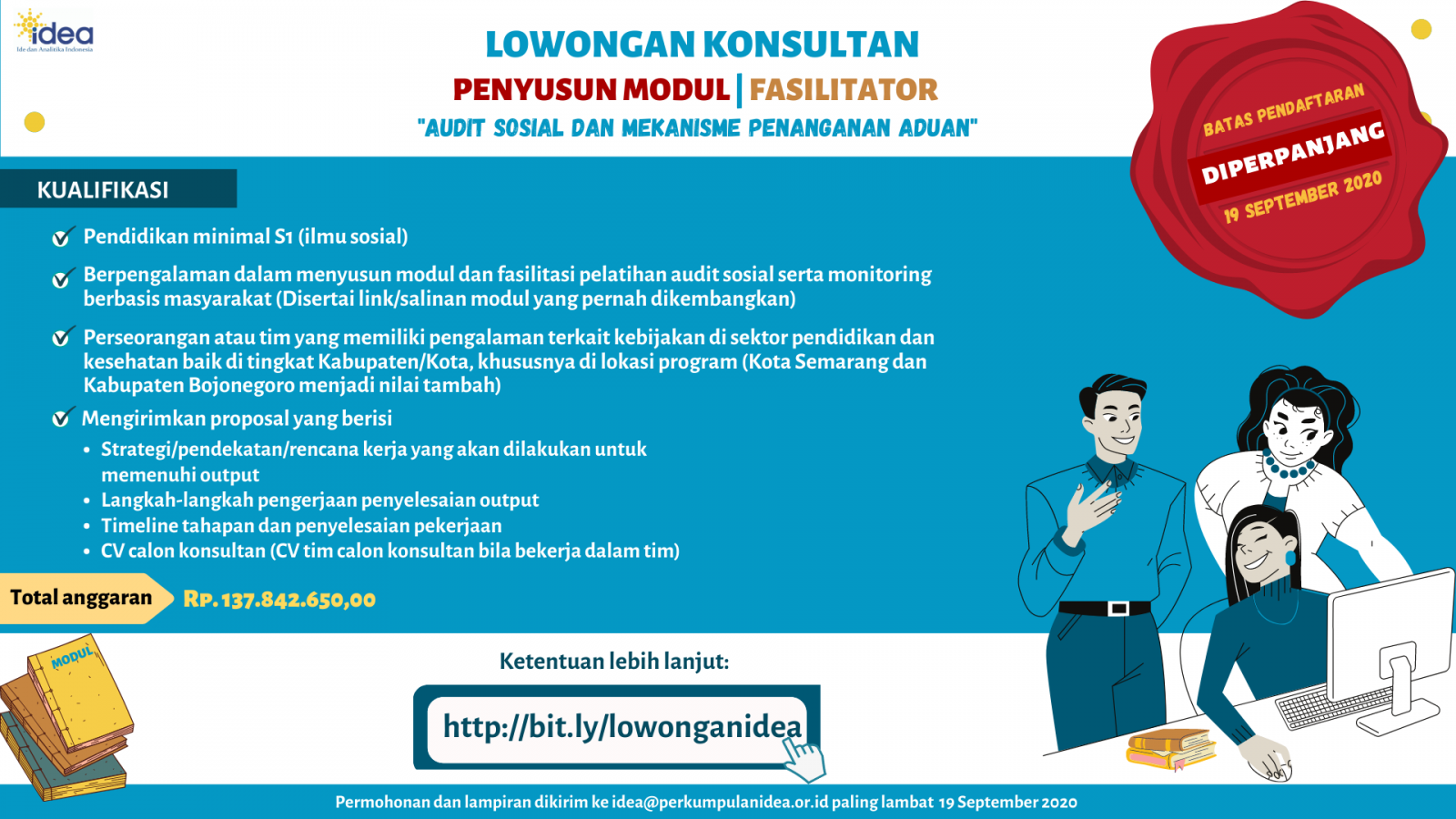
One of the efforts to strengthen the participation of women's groups in regional budget planning is by conducting community-based monitoring. To that end, the IDEA Association will compile two training modules consisting of 1) Social Audit Module and 2) Citizen Complaint Handling Mechanism Module. Both modules will be used to improve the ability of women's groups in monitoring government programs in Bojonegoro Regency and Semarang City, especially in the education and health sectors. In order to compile the two modules above, the IDEA Yogyakarta Association will open a procurement of consultant services. The consultant who compiles the module is also tasked with implementing the module that has been compiled. The implementation of the module in question is to become a facilitator for the Training of Trainer (ToT) for the Social Audit Module, so that community leaders involved in the ToT carry out social audits independently with their respective communities.
For more information, download the document below. If you are interested and qualified, please send your application file to idea@perkumpulanidea.or.id no later than September 19, 2020.
 English
 Bahasa Indonesia