

The status of the Community Activity Movement Restrictions (PPKM) in the Special Region of Yogyakarta Province has been raised again as of February 7, 2022, to level 3. Previously, for more than three months, starting from October 19, 2021 to February 6, 2022, the status in the Special Region of Yogyakarta Province had dropped to level 2. The PPKM level 3 status indicates a re-increase in the number of infections and the spread of the COVID-19 virus.
If we look at the number of daily confirmed cases in the last 60 days in the Province of DIY, the additional cases in DIY have indeed started to increase again since February 6, when there were 280 confirmed positive COVID-19 patients, cases then increased significantly until they peaked on February 24, reaching 2,866 confirmed positive COVID-19 patients. In fact, previously with the high vaccination achievement in DIY as of February 2, which reached 103% for dose 1 and 94% for dose 2, the number of COVID cases could be suppressed well. This is in accordance with the data on the relatively small average number of confirmed positive cases in 1 month, which is 15 on average confirmations as of December 31, 2021 - January 31, 2022. In fact, as of January 1, the confirmed positive case in the Province of DIY was only 1 person. This shows that accelerating the vaccination program is very important to form herd immunity in the community.
The increase in the number of positive confirmations in DIY is indeed caused by many variables, such as the mutation of the SARS virus from delta to omicron, to the possibility of a decrease in the efficacy of the COVID-19 vaccine. Therefore, a vaccination booster to increase community immunity against the COVID-19 virus mutation needs to be carried out. Referring to data from the DIY health service, the third dose of vaccination (booster) for residents in DIY is still very low.
As of March 1, 2022, the achievement of the third dose of vaccination in DIY has only reached 10%, with the number of vaccine recipients being 292,373. Meanwhile, DIY itself has a vaccination target of 2,879,699. This means that there are still a lot of targets that need to be intervened with the 3rd dose of the vaccine, especially vulnerable groups such as the elderly and children.
Based on the target, the number of third dose vaccines in DIY has only targeted health workers, public servants, the elderly and the general public. Meanwhile, for adolescents, it has not been done at all. For health workers, the number of achievements has reached 130%, which is quite understandable considering that health workers are the front line and at the same time the most vulnerable group in health care, especially COVID-19 patients. For public services, the number of achievements is 1.7% or only 5,909 have been vaccinated out of 658,80 targets. For the elderly, the number of booster vaccine achievements is also still very low, which is 13.7% or only 65,096 have been vaccinated out of 472,852 targets.
Meanwhile, for the general public, the number of achievements is 10%, or only 177,257 have been vaccinated out of 1,726,698 targets. Meanwhile, for teenagers and children, as previously explained, it is still 0% or has not been done at all. One of the reasons is because the distance between the second dose of the vaccine has not reached the requirements for a booster.
From the data above, at least it is clear that there are still many gaps that must be intervened so that residents have more protection from the potential emergence of new variants of the SARS Covid-19 virus mutation. The target of booster vaccination certainly also needs to be done by mapping the priority of vulnerable groups, especially groups with disabilities whose data is not yet adequate.
Based on the policy paper submitted by FPRB DIY to the DIY provincial government, disaggregated data showing people with disabilities exposed to Covid-19 is not available on the corona.jogjaprov.co.id website. Meanwhile, disaggregated data will be a reference in the preparation of policies and implementation in handling Covid-19 that is inclusive of people with disabilities.
DIY has made progress in terms of protecting and fulfilling the rights of the disabled, including the existence of DIY Regional Regulation Number 4 of 2012 (which is currently being amended), the existence of the DIY Disability Committee which plays a role in ensuring the implementation of protection and fulfillment of the rights of the disabled, a special health insurance policy (jamkesus) to guarantee the fulfillment of assistive devices, and currently the Province of DIY is preparing itself to become an Inclusive Province. However, protection of the disabled is still not reflected in the program
handling Covid-19 consistently and comprehensively. The situation is confirmed by the following facts:
- The lack of adequate information regarding Covid-19 provided by the government that can be accessed by people with disabilities, especially the blind and deaf.
- The lack of adequate information regarding Covid-19 provided by the government that can be accessed by people with disabilities, especially the blind and deaf.
- The lack of accessible shelters for the disabled, especially the visually impaired and physically disabled who use wheelchairs, has resulted in the rejection of the visually impaired in one of the shelters managed by the government and the disabled being asked to self-isolate at home.
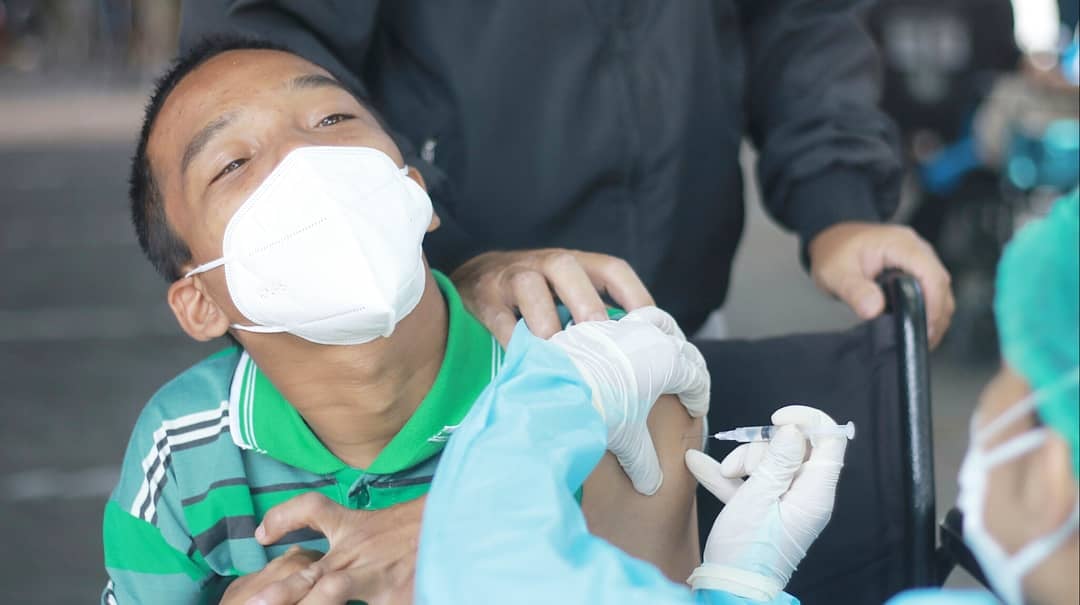
- The implementation of vaccines for people with disabilities by the government which is separated from the general public with a quota system, centralized and limited in implementation time makes it difficult for people with disabilities to access.
- The lack of vaccine education prepared by the government to reach people with disabilities and their families has resulted in some families of people with disabilities refusing to accept the vaccine.
- There has been no opportunity for disabled people to participate in efforts to mitigate and handle Covid-19.
The Role of Civil Society in Collaborating to Accelerate Vaccination
During the pandemic situation, IDEA together with Yappika Action-Aid, FPRB-DIY and several civil society groups and individuals in DIY participated in accelerating vaccination for vulnerable groups in DIY. In the first stage with a two-dose vaccination package, the vulnerable groups targeted were more than 2500 residents living in the province of DIY. The vaccination target was increased in the second stage with a two-dose vaccine package targeting all groups in villages through the jimpitan vaccination scheme. This scheme was collaborated by IDEA and FPRB DIY with the Sambatan Jogja (Sonjo) forum. The target was quite fantastic, namely 38,955 residents from districts with low vaccination rates, namely Gunungkidul, Bantul and Kulon Progo.
In Kulon Progo Regency, overall vaccination was held in 10 villages. The number of targets in the 10 villages was 10,129 people. Of that number, based on vaccination implementation data, the targets who attended were
8,118 people. Of the attendance, the target who were successfully vaccinated was 5,831 people, each with 3,448 doses of vaccine 1 and 4,577 doses of vaccine 2. Meanwhile, the target who were not vaccinated was 92 people.
Then in Gunungkidul Regency, vaccination was held in 5 villages with a target of 5,399 residents. Of that number, 4,846 residents were successfully vaccinated. Based on these results, it indicates that the vaccination achievement in the five regions has reached 88%. Only 13% of residents from the total target have not been successfully vaccinated. Residents who have not received the vaccine number 689 people, with details of 89 people postponed and 600 people absent.
Meanwhile, in Bantul district, the number of Jimpitan vaccination targets in Bantul Regency was 23,291, which was summarized from 16 villages. Of that number, 16,263 people were present. Of the 16,263 targets who were present, 15,713 people were successfully vaccinated, while 710 others were postponed due to several medical considerations.
The experience above illustrates the good practice of the role of civil society in collaborating to accelerate vaccination in the Province of DIY. The impact is quite significant considering that DIY is the province with the second highest number of vaccination achievements nationally, even exceeding the national target.
 English
 Bahasa Indonesia